
- 01.Texas sales tax treatment depends on the actual deliverables in a managed IT agreement, not the contract label.
- 02.Qualifying data processing generally receives a 20 percent exemption, but hardware, software, and bundled charges can follow different rules.
- 03.Hosted-technology rules are changing: proposed Rule 3.308 amendments published November 20, 2026 are not yet final, so cloud, SaaS, and hosting charges require current review.
When Are Managed IT Services Taxable in Texas?
A Houston office manager receives two IT proposals with similar monthly prices, but different sales tax totals. One taxes the entire fee; the other taxes only selected charges. Before comparing costs, the business needs to ask: are managed IT services taxable in Texas? Often, at least part of the package is taxable, but the answer depends on what the provider actually delivers.
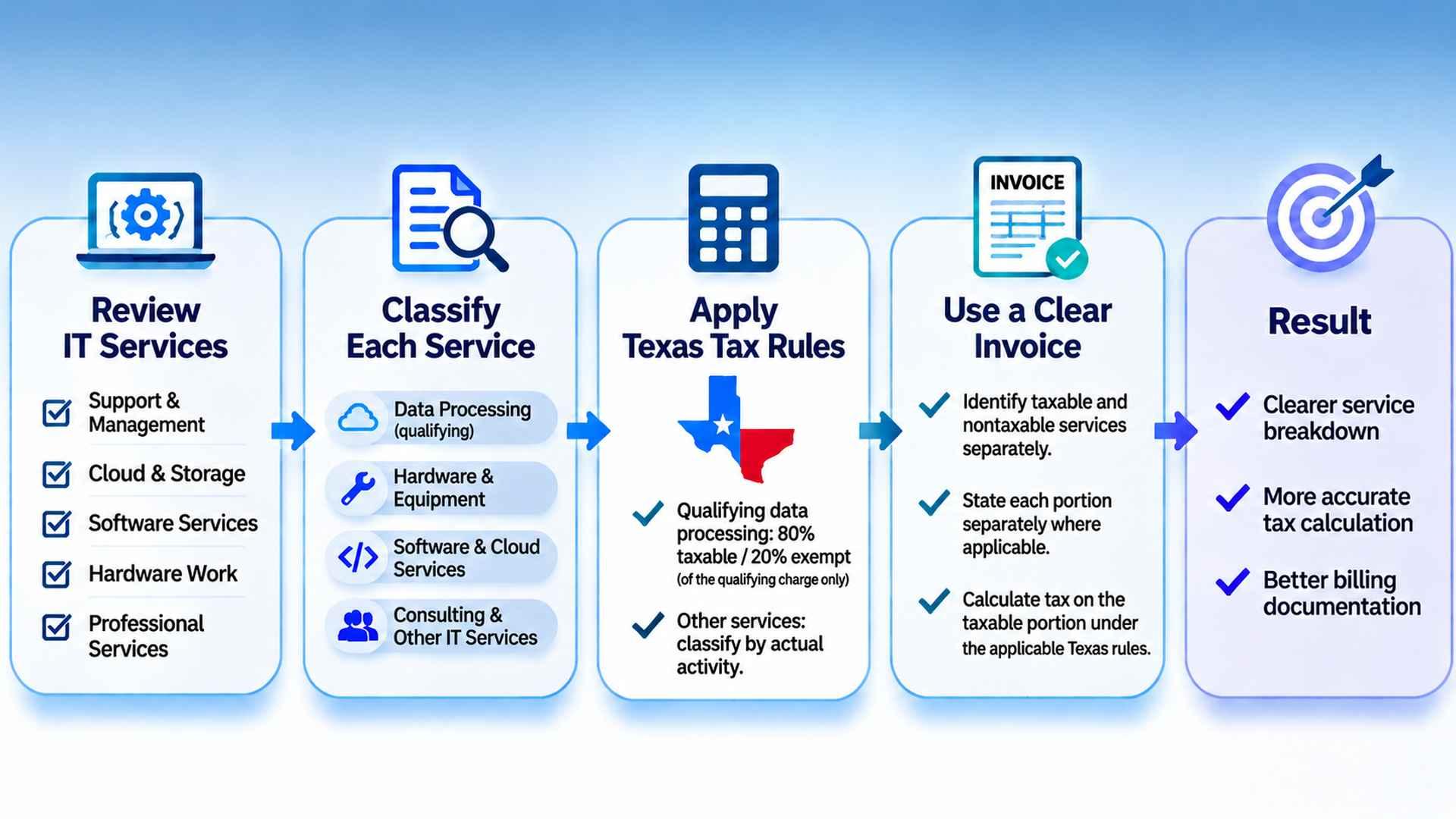
Texas taxes specified services and most goods, rather than everything labeled managed IT. Data processing, hardware maintenance, software sales, and professional advice can receive different treatment. Understanding Texas sales tax on IT services starts with separating these activities. This is general information, not individualized tax advice.
Texas Tax Code Section 151.0101 lists taxable service categories that can appear inside an MSP agreement. A recurring subscription, remote connection, or managed-service label does not establish the category by itself. Start with the deliverable: storing files, repairing equipment, selling software, or advising management. Each describes a different transaction, even if the invoice calls everything support.
When owners ask, “are managed services taxable?”, they should request a scope breakdown before accepting a blanket answer. Separate data storage from equipment repair, software licensing, and advice. DEFCOR’s guide to choosing a managed IT provider provides broader purchasing context; tax review adds another layer to that evaluation.
Identify What the Monthly Fee Actually Buys
Read the scope as deliverables. Labels such as support, cloud management, or cybersecurity do not establish tax treatment. A security engagement might involve advice, software, or work on customer data. Establish what the team supplies before assigning a category to the fee.
Data Storage and Hosted Applications
As of November 23, 2026, the Texas Comptroller’s current taxable-services guidance still lists data storage, including offsite electronic backup, as taxable data processing and also lists software as a service providers in that category. That makes Texas sales tax on digital services relevant to ordinary office tools. For a scope example, DEFCOR’s backup and disaster recovery services cover more than storage alone; review each deliverable instead of treating an entire recovery plan as one storage charge.
Regulatory Update: Proposed Rule 3.308 (November 2026)
Texas is actively reconsidering the treatment of hosted technology. The Comptroller published proposed amendments to Rule 3.308 on November 20, 2026. The proposal would clarify that internet hosting and other hosted technology services are not data processing services and are not taxable under the Tax Code. The proposal is not final, and public comment closes December 20, 2026. Businesses reviewing cloud, SaaS, hosting, or similar charges should confirm the rule and guidance in effect for the transaction period before relying on a tax classification.
Hardware Repair and Maintenance
Texas generally taxes labor to install, repair, maintain, or restore computer hardware. Calling a charge labor does not make it exempt. An equipment maintenance component therefore needs its own review, even when included with remote support. The partial exemption for data processing does not automatically reduce the taxable charge for hardware work.
How Texas Treats Software Support
Who sold the software can change the answer. Under Comptroller Rule 3.308(c)(2), repair, maintenance, and restoration performed by the program’s seller are taxable. Texas Tax Code Section 151.0101(a)(5)(D) excludes specified program work from the taxable property repair category when the person doing it did not sell the program. Keep evidence of the original seller and the actual repair work.
For example, a vendor correcting errors in software it sold generally supplies taxable maintenance. An independent developer repairing software bought elsewhere may qualify for different treatment. A license sale, hosted application, and accompanying hardware work require separate classification. Professional advice needs examination on its merits; a consulting label alone cannot make delivery exempt.
Understand the 20 Percent Data Processing Exemption
For qualifying data processing, Texas Tax Code Section 151.351 exempts 20 percent of the value from sales and use tax. Tax generally applies to the remaining 80 percent. This reduces the taxable base; it is not a 20 percent tax rate. Under Rule 3.330(c)(4), the exemption does not apply if the service is also taxable under another service category, except information services.
Classification comes before calculation for Texas sales tax on IT services. Applying the 80 percent base to every support charge can understate tax on fully taxable work. Taxing qualifying data processing in full can overstate it. Accounting needs the category beside the amount to understand the difference.
An Illustrative Invoice Calculation
Assume a separately sold data processing service costs $1,000 and the applicable combined rate is 8.25 percent. The taxable base is $800, producing $66 in tax and a $1,066 total. By comparison, $1,000 of fully taxable hardware maintenance at that assumed rate produces $82.50 in tax. These are illustrations, not DEFCOR prices or classifications of any actual package.
Texas imposes a 6.25 percent state rate, with local taxes potentially bringing the combined rate to 8.25 percent. The maximum is not the rate for every transaction. Confirm the applicable local sourcing and rate before budgeting. Two providers showing different effective percentages may be using different taxable bases, so ask for both the base and rate.
Why Bundled Agreements Need Closer Review
For a combined fee, tax treatment depends on the relationship between the services. Comptroller Rule 3.330(a)(1)(C) excludes processing from its definition when that processing has no separate value and is ancillary to another service. The taxpayer must substantiate both conditions. If the other service instead lacks separate value and is ancillary to processing, the charge is taxable as data processing.

When services have separate value, Rule 3.330(e) addresses qualifying nontaxable related services. They must be distinct, identifiable, and commonly supplied independently. If taxable services exceed 5 percent of a single fee, the whole fee is presumed taxable. Reasonable separate charges can overcome that presumption, with records supporting the allocation. The limited rule for an unseparated taxable share of 5 percent or less is not a general exemption for IT contracts.
Suppose a $1,000 package genuinely includes $700 of backup storage and a $300 advisory assessment that the provider also sells independently. With no separation, the taxable share exceeds 5 percent. A defensible allocation can isolate the assessment from the taxable storage charge. The practical distinction is evidence: an independently useful assessment with its own scope differs from relabeling routine storage administration as advice.
For a hypothetical Dallas law firm, one subscription might combine backup storage, equipment maintenance, and technology planning. Those descriptions start the analysis; they do not establish a final tax answer. DEFCOR’s managed IT and support services illustrate the range of operational work an agreement can include, so request a proposal that describes the work clearly enough for accounting review.
How Texas Sales Tax Applies Across State Lines
An out-of-state provider does not automatically remove Texas obligations. Rule 3.330 addresses use tax on taxable data processing when the seller does not collect the correct tax. The question “are managed services taxable?” therefore remains relevant when purchasing remotely: examine where the service is used rather than assuming the vendor’s address settles the issue.
Rule 3.330(g) addresses multistate use. A reasonable allocation must be supported by business records; services supporting general administration have a principal-place-of-business rule. A multistate use certificate shifts reporting responsibility to the purchaser rather than erasing tax. Reviewing Texas sales tax on digital services therefore requires identifying which operations benefit before choosing an allocation method.
Review a Proposal Before Approving Payment
Before approving a proposal, connect the tax treatment to the contract. Collect these three items so the reviewer can distinguish an arithmetic error from a classification dispute:
A useful check for Texas sales tax on IT services is whether another reviewer can reproduce the bill. Multiply each taxable line by its taxable proportion and applicable rate, then reconcile the sum. Identify rounding, omitted charges, or disputed classifications before requesting a correction.
Review Texas sales tax on digital services purchased outside the MSP agreement too. A business might pay its software vendor for access and its MSP for administration. Keep a subscription register showing each seller, deliverable, invoice, and tax collected. This helps distinguish duplicate charges from separate services without assuming they share a classification.
- A service breakdown identifying software, hardware work, data processing, and separately delivered advice.
- The taxable base, applicable rate, exemption treatment, and written explanation of any bundled allocation.
- Supporting agreements, exemption documentation where applicable, and an owner for resolving billing discrepancies.
Resolve Uncertainty Before the Next Renewal
On a disputed bill, the headline question is only the starting point. Identify the line and the alleged error: classification, taxable percentage, location, or arithmetic. Preserve the original invoice and relevant contract excerpt. A repair charge incorrectly given the data processing reduction needs a different correction from a duplicated software charge.
If the tax treatment remains unresolved for your contract, ask a Texas sales tax professional to review the invoice and the provider’s explanation. Match any resulting credit or revised invoice to the original period, with reporting consequences determined before posting the adjustment.
Revisit “are managed services taxable?” when the scope changes. Adding hosted applications, changing the software seller, or including hardware maintenance can alter the analysis. Keep the revised scope with the prior assessment so finance can identify the change without rebuilding the review.
Final Thoughts
So, are managed IT services taxable in Texas? Often, some components are. Before approving a contract, require an explanation that connects each deliverable to its tax treatment. If the provider cannot distinguish the software sale, technical work, and advice, resolve that gap before relying on its total. The useful result is an invoice your business can explain and review when the service changes. Because Texas is currently considering changes to the treatment of hosted technology, confirm the rule in effect for the period you are reviewing.
Frequently Asked Questions
Are managed IT services taxable in Texas?
Often, some components are taxable. Treatment depends on the services supplied, including data processing, hardware maintenance, and software transactions.
Does the data processing exemption eliminate tax?
No. Qualifying data processing generally has a 20 percent exemption, leaving 80 percent of the charge taxable.
Can a bundled fee include nontaxable advice?
Yes, but qualifying advice must be distinct and supported by reasonable charges and records. Invoice labels are insufficient.
Does an outside provider avoid Texas tax?
No. Taxable services used in Texas may create use tax obligations when the seller does not collect tax.
Defcor Team
. Part of the Defcor engineering team that builds and manages autonomous AI phone agents, IT systems, and automation infrastructure across Texas.