- 01.AI-generated human voices fall under TCPA artificial-voice restrictions; legality depends on call purpose, destination, consent, and applicable exceptions.
- 02.Promotional artificial-voice calls to consumer mobile numbers or residential lines generally require prior express written consent; a purchase or CRM entry alone does not establish that permission.
- 03.Operational compliance should include suppression updates, opt-out testing, calling-hour controls, state-law review, records, and clear human ownership of exceptions.
Are AI Outbound Calls Legal Under the FCC Ruling
A Houston service company wants an AI agent to call yesterday’s inquiries. The software is ready, but the records show only names and phone numbers. Before uploading that list, the owner needs to ask: are AI outbound calls legal for these recipients and this purpose? A working dialer and a plausible business reason do not establish permission.
Yes, AI outbound calls can be lawful. The FCC treats AI-generated human voices as artificial voices under the Telephone Consumer Protection Act, or TCPA. Legality depends on the destination, message, consent, and applicable exceptions. This overview reflects federal sources reviewed on November 11, 2026. It is general information, not legal advice; campaign approval requires advice specific to your business.
The FCC’s declaratory ruling released February 8, 2024 applied existing artificial-voice restrictions to AI-generated voices, including voice cloning. It did not prohibit every business use of voice AI. A system that creates spoken answers during a conversation still uses an artificial voice, even when nothing was recorded beforehand.
That distinction matters when a vendor says its platform avoids autodialer restrictions. Artificial-voice restrictions provide a separate basis for TCPA coverage. Having an employee click the dial button does not remove the artificial voice from the call. DEFCOR’s outbound calling guide explains the operational workflow; this article focuses on the permission needed before that workflow starts.
Marketing and Informational Calls Need Different Reviews
Under 47 CFR 64.1200, ordinary commercial telemarketing using an artificial voice to mobile numbers or residential lines generally requires prior express written consent. Informational AI calls to mobile numbers generally require prior express consent unless an exception applies. Residential informational calls have specific exemptions and limits; they are not permission to run unrestricted campaigns.
For TCPA AI calls, classify the whole conversation. An appointment reminder differs from a promotion for another service. Adding a maintenance offer can change that. Review optional branches too: an agent authorized to confirm a visit should not improvise an offer because the customer mentions another problem.
A Customer Relationship Does Not Settle Consent
An earlier purchase, a missed call, or a number in your CRM does not automatically authorize artificial-voice marketing. Keeping AI outbound calling legal requires evidence matching the campaign’s purpose. A requested callback needs review too; permission for a person to respond does not automatically cover AI marketing.
For existing customers, the legal question turns on what the customer authorized. Keep the disclosure, required signature, authorized number, date, source, and withdrawal history. A CRM field marked “subscribed” is weak evidence when nobody can reconstruct the agreement or explain which communications it covered.
Written consent requires a signed agreement clearly authorizing the seller’s artificial or prerecorded voice marketing calls to the specified number, with disclosure that consent is not a condition of purchase. Electronic signatures can qualify. Have counsel check the collection form and stored evidence against the requirements that apply to your campaign.
Is AI Cold Calling Legal in the US?
For unsolicited promotional AI calls to consumer mobile numbers or residential lines without required written consent, the general answer is no. Buying a list does not supply that consent. Outreach supported by applicable authorization needs a different analysis from a genuinely unsolicited pitch.
Business Numbers Are Not a Universal Exemption
A business owner’s mobile phone remains a wireless number for the relevant federal artificial-voice restriction. A business landline can present a different TCPA analysis, but that does not remove every federal or state obligation. For the question “is AI cold calling legal in the US,” a “B2B exempt” label is insufficient.
A spreadsheet label cannot answer call eligibility: verify the actual line type and audience. The FTC’s Telemarketing Sales Rule has its own scope and exemptions, and state requirements can differ. Moving a campaign to another dialing provider changes neither the recipients’ consent history nor the obligations attached to those calls.
Purchased Leads Need Evidence Beyond a Supplier Promise
Ask the supplier for the disclosure, evidence of agreement, and seller and number covered. In Insurance Marketing Coalition Ltd. v. FCC, the Eleventh Circuit on January 24, 2025 vacated additional FCC restrictions requiring consent to one seller at a time and a logical and topical connection. Existing written-consent requirements remained.
A purchased list therefore leaves the question unresolved until its evidence is examined. Unsupported records should stay out of the campaign. A supplier contract can allocate responsibilities, but its assurance does not establish that the recipient authorized your artificial-voice marketing or has not since withdrawn consent.
Permission Must Survive the Calling Workflow
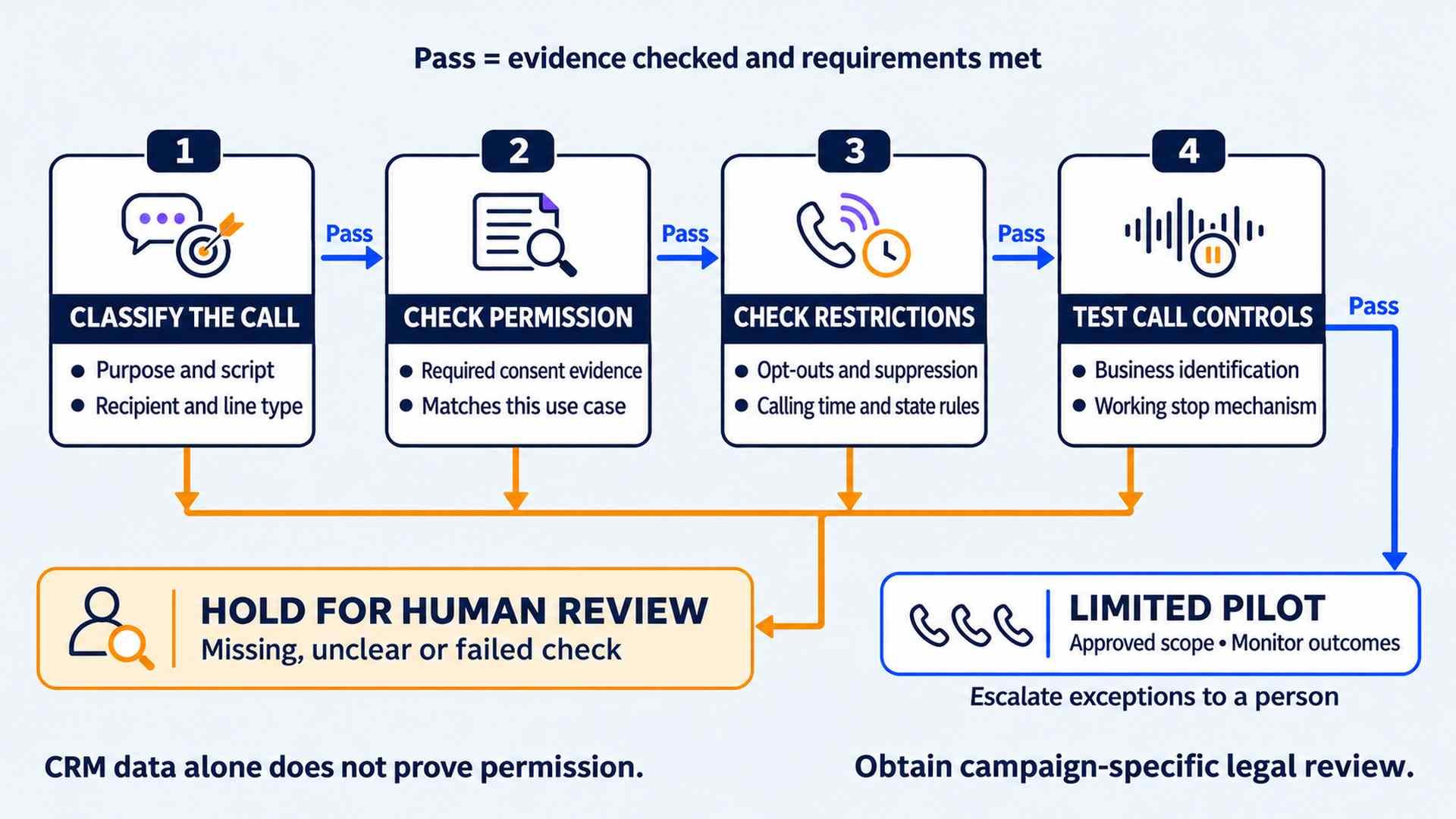
Initial consent is only the starting point. A withdrawal may sit in a support inbox while the dialer keeps calling; a copied list may retain someone removed from the CRM. Recheck call eligibility whenever lists, scripts, or campaigns change. Suppression updates must reach queued calls and retries, not just the main customer record.
Identification and Stopping Calls
Artificial-voice messages must identify the responsible entity at the beginning and provide required callback information. Covered marketing calls and certain exempt residential calls also require automated opt-out instructions within two seconds after identification. The mechanism must add the number to the caller’s do-not-call list and immediately end the call; voicemail needs a toll-free route to it.
These duties appear in 47 CFR 64.1200(b). Identifying the business, disclosing AI use, and obtaining consent serve different purposes. As of November 11, 2026, the FCC’s 2024 proposal for additional AI-specific disclosures should not be treated as a final nationwide AI-disclosure rule. Check applicable National Do Not Call and company suppression requirements independently of artificial-voice consent.
For TCPA AI calls launched before November 25, 2026, honor reasonable consent-revocation methods within a reasonable time, no longer than ten business days. That processing limit does not postpone the immediate termination required when someone uses the automated opt-out mechanism. Test spoken stop requests and keypad responses before enabling retries.
From November 25, 2026, the published FCC amendments allow category-specific informational revocations and designated exclusive methods under stated conditions, including clear disclosure. Marketing revocation covers future marketing calls and texts from that caller. Existing automated opt-out obligations remain. Approve the revised workflow before switching methods; do not treat the amendment as permission to ignore withdrawal requests today.
Calling Hours and State Obligations
Federal telephone-solicitation rules generally use an 8 a.m. to 9 p.m. window at the recipient’s location. State rules may be stricter. Texas businesses should also review state solicitation, registration, and automated-calling requirements. If calls are recorded, assess recording consent separately; permission to receive a call does not automatically resolve permission to record it.
To keep AI outbound calling legal as operations change, assign an employee to own suppression updates, script approval, and complaints. DEFCOR’s lead follow-up automation is relevant to implementing customer workflows, but an integration must support your actual permissions and processes. Access to a CRM or calendar is not proof that its data authorizes calling.
Budget for Controls Before Comparing Call Prices
Before comparing AI outbound calling cost, confirm that the proposed campaign has a lawful permission basis. Include configuration, telephony, integrations, consent capture, suppression checks, testing, monitoring, and staff escalation in the budget. Ask which charges apply to unanswered calls, voicemail, transfers, and retries; a low usage price excludes work needed to enforce the approved scope.
An AI outbound calling cost comparison should use the same permitted audience and service task for each vendor. Cheap access to a larger list is not equivalent value if those numbers lack usable authorization. Ask whether records, script versions, call outcomes, and opt-out events can be exported when changing providers or investigating a complaint.
Test One Permitted Use Case Before Expanding
Return to the Houston company. Its manager’s question, “Are AI outbound calls legal for yesterday’s inquiries?” requires reviewing records individually. An appointment confirmation with applicable documented permission may enter a pilot; a promotional callback supported only by a name and number stays on hold. The office manager owns eligibility, with counsel resolving uncertainty. Staff review exceptions before calls resume.

Measure permitted task completion, failed transfers, and suppression failures during the pilot. Review recordings only where lawful and access is controlled. For TCPA AI calls, retain the evidence explaining each call’s eligibility, including the approved script version and suppression check. Include oversight in AI outbound calling cost: a completed conversation is not success if the call should never have started.
DEFCOR describes workflow automation that connects business systems and supports approvals and fallback paths. For outbound campaigns, request a demonstrated stop mechanism when permission records cannot be checked. The exact integration depends on platform access and implementation.
- Hold calls when consent evidence, line type, or suppression status is unresolved.
- Test stop requests, wrong numbers, voicemail, and failures to update the CRM.
- Assign a person to handle complaints, uncertain permissions, and requests for human help.
Conclusion
The practical answer to “are AI outbound calls legal” starts with one proposed call: who receives it, why it is being made, and what authorizes the artificial voice. If any answer is missing, pause that use case. Establish the permission and operating rules first, then choose technology that can enforce them and show when enforcement fails.
Frequently Asked Questions
Are AI outbound calls legal?
Yes. Legality depends on call purpose, destination, consent, applicable exceptions, and federal and state requirements.
Do marketing calls need written consent?
Artificial-voice marketing calls to consumer mobile numbers or residential lines generally require prior express written consent, subject to applicable exceptions.
Can recipients stop future calls?
Yes. Honor applicable revocation and suppression requests. Artificial or prerecorded telemarketing calls subject to the rule must provide the required automated opt-out mechanism, which records the do-not-call request and terminates the call.
Defcor Team
. Part of the Defcor engineering team that builds and manages autonomous AI phone agents, IT systems, and automation infrastructure across Texas.