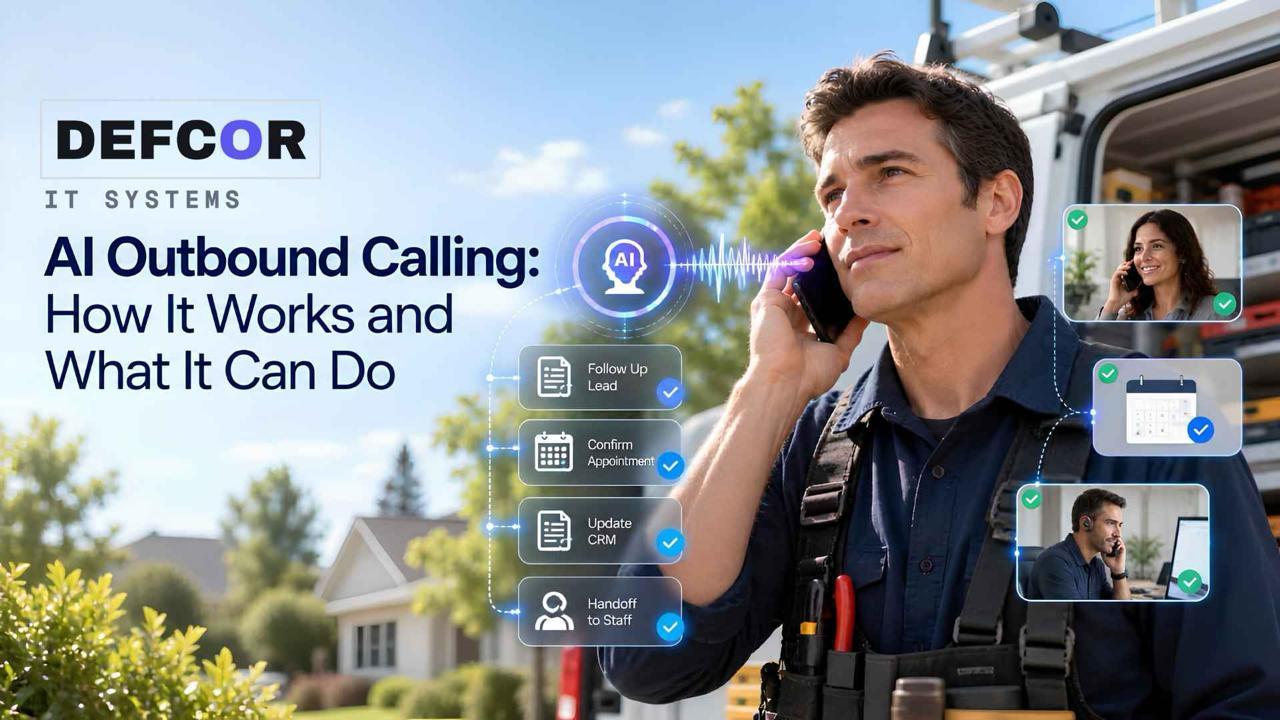
- 01.AI outbound calling works best for expected, clearly defined calls such as callbacks, reminders, and confirmations.
- 02.The system should check permissions, current records, and opt-out status before dialing.
- 03.Complaints, negotiation, sensitive situations, and uncertain requests should be handed to a person.
What an outbound AI call actually does
Imagine an HVAC company receiving an estimate request while its office staff are handling other calls. By the time someone follows up, the homeowner may have booked elsewhere. AI outbound calling could help with a timely response, provided the company has permission to call, accurate information to share, and a clear route to a person when the conversation needs one.
An inbound agent answers a customer’s call. An outbound agent calls because a requested callback, appointment, or service update has triggered a task. It can interpret replies, ask approved questions, and record outcomes. Its instructions must also say when to stop, leave a permitted message, or transfer to staff.
Unlike a simple prerecorded message, outbound AI voice agents can interpret a reply and choose an approved response. A useful implementation connects the conversation to a customer record and next action. It may offer a confirmed alternative appointment, but should route a disputed charge to staff. Being conversational does not exempt an AI-generated voice from rules governing artificial voice calls.
The trigger, context, and call flow
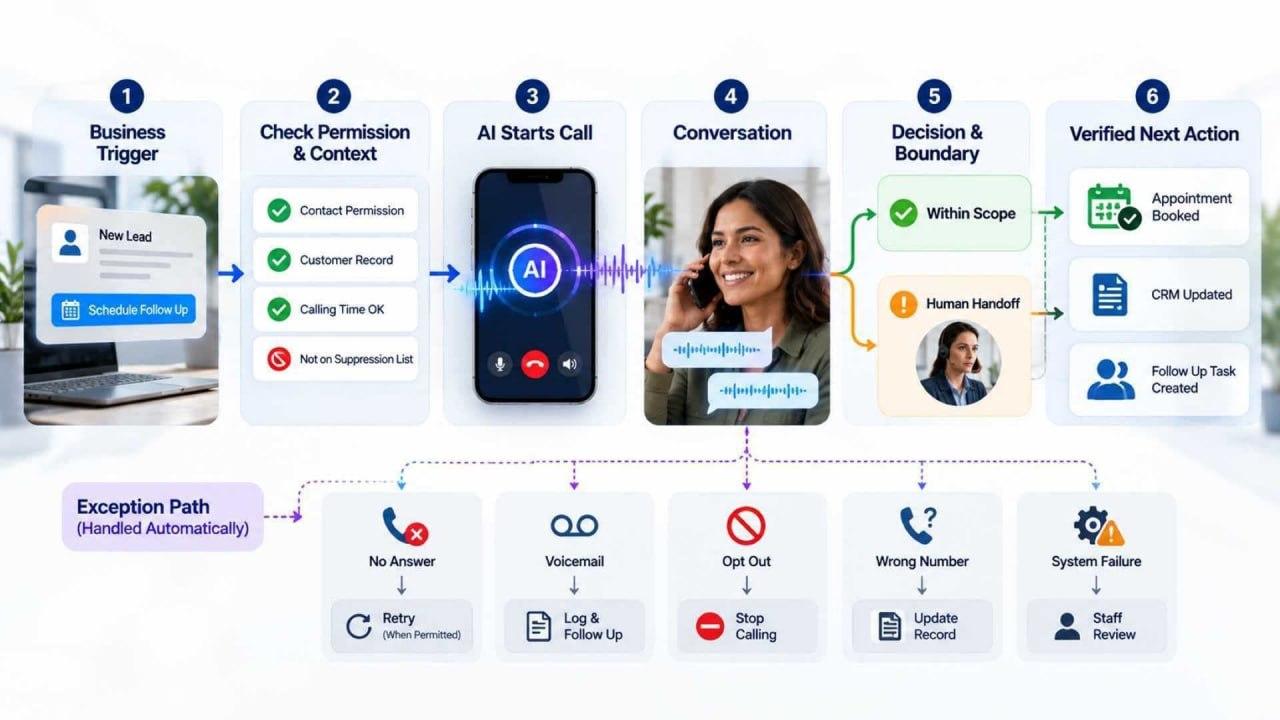
To understand how AI outbound calling works, follow one call. A form or CRM change creates a task. Before dialing, the system checks its purpose, consent record, local time, and suppression status. An approved flow provides the requested service and available appointment windows. Telephony connects the call; speech recognition interprets replies; voice generation speaks; a workflow records the outcome.
A complete process map must include unanswered calls, voicemail, wrong numbers, requests for staff, and opt-outs. A fresh CRM check prevents another call to someone who has booked or declined contact. Uncertain status holds the task for review.
The point where a human takes over
Outbound AI voice agents can confirm a time, collect a callback window, or connect someone to staff. People handle complaints, negotiation, sensitive disclosures, and unusual requests. Transfers should include the context already gathered.
An estimate call can identify the company, check whether it is a good time, and arrange a staff callback. It cannot promise a technician without dispatch confirmation or negotiate a custom quote.
Where a small business can use it
The strongest AI outbound calling use cases begin with a request or a customer task whose purpose the recipient will recognize. That context makes the call useful; it does not, by itself, establish permission for every type of automated call.
Requested callbacks and lead follow-up
A prospect asks to speak with a company while its employee is on a job. If the call is permitted, the agent can confirm the inquiry and offer a staff callback or an available slot. It should accept a request to stop without requiring the person to hear a pitch. DEFCOR describes related follow-up workflows; any outbound campaign needs its own permission checks.
An email request does not necessarily invite a voice call. Record exactly what the prospect requested and when. Calling to answer that inquiry and calling later to promote a maintenance plan have different purposes; the latter needs its own permission review. Even a requested phone conversation is not blanket consent for automated marketing.
A missed call deserves the same care. The phone system may show a number but not why its owner called or whether an automated return call is permitted. Where a callback is appropriate, the agent can identify the business, ask what help was needed, and arrange a staff conversation. It should not infer a sales lead from the number alone.
Appointments and operational updates
A contractor or property manager may need to confirm a visit or relay a schedule change. The agent can offer approved options and update a shared record. It should not reveal private details to whoever answers; sensitive or regulated conversations need more careful identity and access controls than a routine reminder.
For an HVAC visit, the agent can confirm a scheduled window or request for staff. It cannot diagnose an emergency, promise arrival without dispatch confirmation, or turn a reminder into a sales pitch.
Service feedback and reactivation
After a job, a short call may ask whether an unresolved issue needs attention. If the customer says yes, an approved integration can create a staff task from the agent’s summary. Reactivating inactive customers requires separate review: a prior purchase does not automatically authorize an AI-generated sales call.
Some outbound calling scenarios are poor fits for AI. Purchased lists create consent and reputation risk; complaints often worsen when a machine repeats scripted questions. In a high-trust service, coordinating a human conversation may be the agent’s entire job.
The outcome after the call
A customer requests an HVAC estimate and a call. After the permission check, the agent confirms the address and offers a slot returned by the calendar. If the customer accepts, the calendar must confirm the write before the agent says the consultation is booked. The CRM then records the agreed time, service request, and employee responsible for preparing the estimate. Booking a consultation does not dispatch a technician or settle a price.
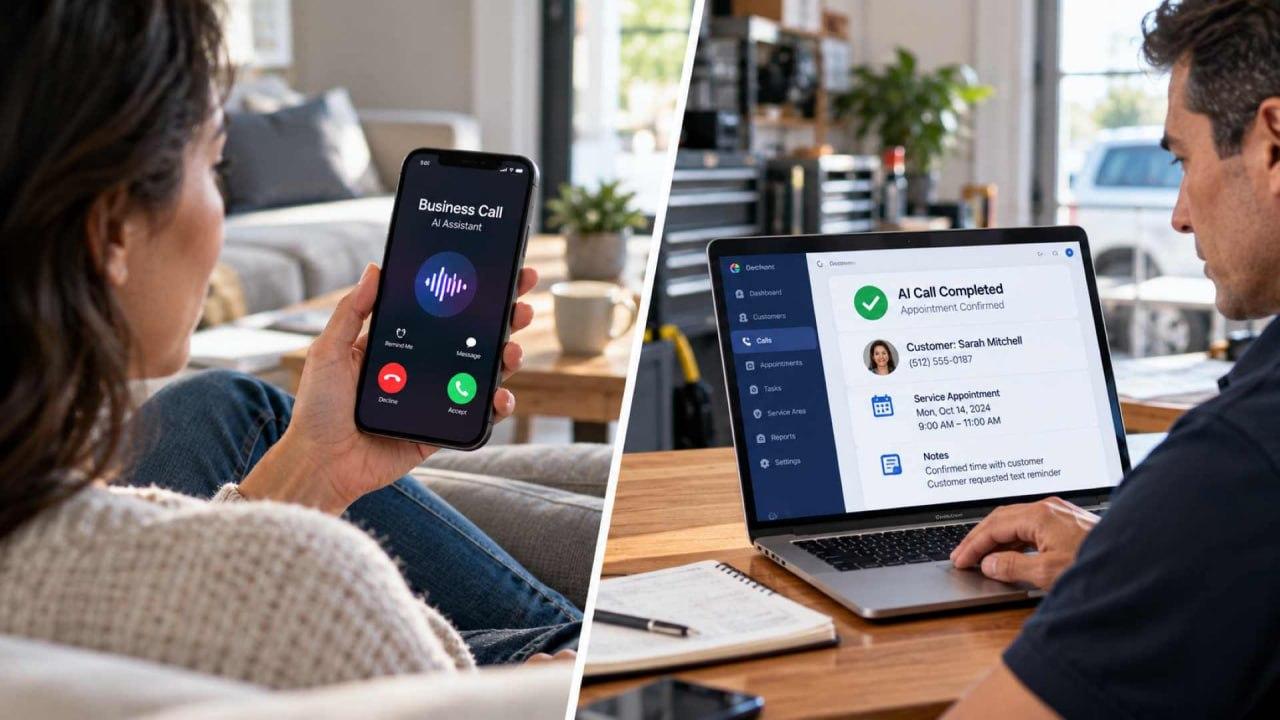
Another customer asks for a firm repair price, which the agent has no authority to quote. It takes the question, offers a human callback, and sends staff the conversation summary; no appointment is claimed. If instead the customer accepts a slot but the calendar rejects it, the agent says the time is unconfirmed and requests staff follow-up. A failed CRM write needs an alert visible to the team. These branches show why completed actions, not conversation counts, determine whether the workflow helped.
The controls that make the system dependable
Good AI outbound calling depends on accurate records, scoped language, and a way to stop when circumstances change. A natural voice can still quote old information or record an action that never happened. Three controls deserve attention before launch.
- Define the permitted purpose, audience, consent evidence, calling window, and suppression rules for each campaign.
- Restrict what the agent may say or change, and route uncertainty, objections, or sensitive requests to a person.
- Log the trigger, version, outcome, opt-out, and handoff so staff can inspect and correct mistakes.
Data and integration checks
The agent should access only the fields needed and write back authorized results. Different calling workflows place different demands on connected tools: a reminder may read an appointment, while booking must also update it. Staff must know which record is authoritative. DEFCOR describes CRM, calendar, and form connections in its workflow automation service; that page does not establish compatibility with any particular customer’s tools. Test each integration and its failure response.
Decide whether calls will be recorded, what notice or consent applies in each relevant jurisdiction, who may access recordings, and how long records are kept. Document how staff correct inaccurate summaries. If someone asks why the company has their number, the agent needs a truthful answer grounded in the contact record.
Permission, disclosure, and stopping calls
U.S. rules require particular care. The Federal Communications Commission has said that calls using AI-generated voices fall within Telephone Consumer Protection Act restrictions on artificial or prerecorded voice calls. The Federal Trade Commission’s telemarketing guidance also addresses sales calls, disclosures, calling times, and requests not to be called. The precise requirements depend on the call’s purpose, recipient, method, and jurisdiction. A live agent exception for an established business relationship should not be assumed to authorize automated voice calls.
Review consent language, recording practices, caller identification, and campaign design with qualified counsel or compliance staff, especially for marketing. Build opt-out handling into connected lists and check again immediately before dialing. The agent should identify the business and avoid implying it is human. A person can withdraw permission after the campaign is configured.
How to run a pilot without losing control
Assess a pilot for outbound AI voice agents with four questions: Is contact permitted for this purpose? Is the source record current? Can approved responses cover likely requests? Who owns an exception? A requested callback may pass; a disputed bill or emergency will not. If one answer is missing, hold the pilot. Test interruptions, voicemail, wrong numbers, failed integrations, and opt-outs with the staff who receive escalations.
Among eligible inquiries, compare the share reaching a verified next step with the current staff process. Check calendar confirmation and completed callbacks against CRM records; count opt-outs, duplicate calls, failed transfers, and complaints. An answered call is not a booking, and a consultation is not a sale. More consistent follow-up may help staff reach interested customers, but any revenue effect must be measured. Repair consent or handoff gaps before increasing volume.
A demonstration of how AI outbound calling works should include an opt-out, a failed calendar write, and a request for staff. Ask whether the system prevents a duplicate call after an employee has responded. DEFCOR’s contact page is a place to discuss whether a particular follow-up workflow is feasible.
Final thought
The best first candidate is a call whose recipient expects the contact and whose result has a clear owner. Write down its permitted purpose, the information needed, the handoff point, and the action that proves it worked. If any of those four answers remains uncertain, resolve it before dialing. A modest pilot that closes the loop on requested callbacks offers a sounder basis for expansion than a large campaign measured by calls placed.
Defcor Team
. Part of the Defcor engineering team that builds and manages autonomous AI phone agents, IT systems, and automation infrastructure across Texas.