
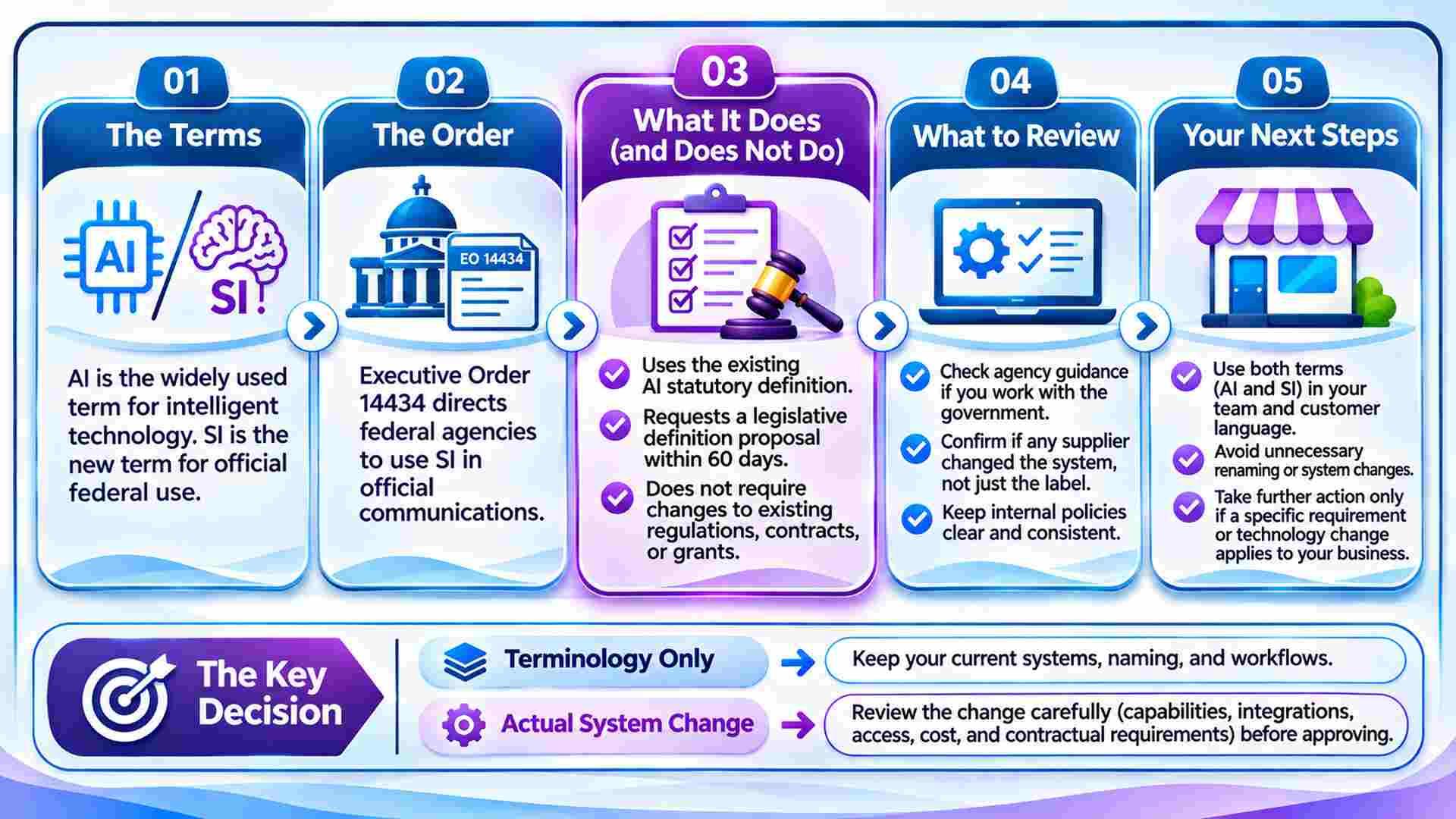
- 01.Executive Order 14434 directs specified executive-branch communications to use "Super Intelligence" and "SI"; it does not create a general private-sector renaming requirement.
- 02.A new label does not prove a software product is more capable; compare functionality, permissions, integrations, pricing, and support.
- 03.Small businesses should change policies, websites, or tools only when a specific requirement or operational change justifies it.
What the Super Intelligence Executive Order Says
Your office manager sees SI on a government webpage while your software subscription still says AI. Should the business update its website, rewrite its policies, or buy something different? The SI vs AI question begins with a real naming change, but the right response depends on who issued the document and what your business needs to do with it.
The question “Has AI been renamed SI?” has a qualified answer: federal executive branch usage has changed. That change does not rename every business and product. The distinction matters most when you interpret agency documents, respond to a proposal, or decide whether a supplier’s new terminology justifies changing an existing arrangement. Start with the scope of the order before changing your own operations.
President Trump signed Executive Order 14434, Inaugurating the Era of Super Intelligence, on September 29, 2026. It appeared in the Federal Register on October 2. Section 2 directs executive departments and agencies to adopt SI terminology in official communications and other non-statutory documents, to the extent permitted by law. Previously issued regulations, contracts, grants, presidential actions, and historical documents need not be altered.
For purposes of the order, Section 3 defines SI by reference to the existing statutory definition of AI in 15 U.S.C. 9401(3), except where law provides otherwise. It also directs a legislative definition proposal within 60 days. A requested proposal is distinct from enacted legislation. This article explains the order reviewed on November 8, 2026; later definitions or agency requirements should be checked when relevant to a particular decision.
Which Businesses Need to Pay Attention
The super intelligence executive order directs executive branch usage; it does not establish a general requirement for private businesses to rename their offerings. An ordinary service company and a business responding to a federal solicitation therefore face different document review questions. Federal suppliers should examine the actual agency instructions and contractual requirements that apply to their work.
For a local company serving private customers, avoid treating unfamiliar vocabulary as an instruction to overhaul working systems. Identify the document’s issuer and intended audience first. A Texas property manager reading a government announcement may need a terminology explanation. A supplier preparing an agency response may need procurement staff or counsel to examine the relevant instructions before submitting it.
SI vs AI Meaning Depends on Context
There are two different discussions behind super intelligence vs artificial intelligence. One concerns the vocabulary used in federal documents. The other concerns how capable a machine might be. A reader can encounter both in the same week, so a useful explanation must identify the intended meaning before drawing conclusions about a product, policy, or technical milestone.
A Federal Label and a Research Concept
Technical research commonly uses superintelligence for a hypothetical system with intelligence far beyond human abilities. The federal terminology discussed here uses a different definitional starting point. Neither a product’s initials nor an updated webpage demonstrates that a system can exercise reliable judgment across unfamiliar situations. Claims about capability need evidence appropriate to the task being proposed.
This is where an SI vs AI comparison can mislead a buyer. A renamed receptionist might use the same model, instructions, and software connections as before. Alternatively, a supplier might have changed important components. Those possibilities require different reviews. Ask what changed in the actual system, then evaluate that change on its own merits rather than assuming either improvement or equivalence.
What to Change in Your Documents and Website
For most owners, the first practical task is communication. Staff should recognize both terms without creating duplicate software entries, contradictory procedures, or confusing customer explanations. Treat the terminology primarily as a vocabulary issue until a specific document requirement or technical change gives you a reason to do more. Your existing product names should remain easy to recognize.
Internal Policies and Customer Language
An employee who asks “Has AI been renamed SI?” needs enough context to continue their work. A glossary entry titled “SI vs AI meaning” can explain federal usage and identify the products your business actually uses. Keep permissions, approved uses, and system ownership attached to recognizable product names. Replacing an acronym throughout a policy can obscure those details if nobody checks the result.
On your website, describe what customers can expect: an automated assistant can collect a request, provide approved information, or offer a booking step where configured. There is little value in adopting terminology your audience may misunderstand without explaining it. If your page discusses super intelligence vs artificial intelligence, clarify the context and avoid presenting the wording as a certification or performance rating.
When customers ask about the terminology, explain how your business uses the technology. Describe who handles their information and how they can reach an employee. For a dental office, terminology does not establish that a specific deployment meets privacy requirements. For a law firm, an automated intake tool still needs boundaries that preserve attorney responsibility for legal advice.
Proposals and Government Documents
For government work, preserve the terminology and defined terms relevant to the document you are answering. Where clarification is needed, an explanatory note can distinguish agency wording from a vendor’s product name. A reviewer should be able to trace the proposed service to its specification, pricing, and responsibilities without guessing whether AI and SI refer to different deliverables.
Assign the person responsible for government submissions to review relevant changes when an agency issues new instructions, a solicitation is amended, or a contract is renewed. Questions about the Super Intelligence executive order belong alongside those actual documents. A general news summary should not become an undocumented instruction for the sales team to rewrite every agreement.
Follow One Service Request Through the System
To see what the SI vs AI distinction changes operationally, consider a hypothetical Houston HVAC office. Its assistant is described as AI in an existing agreement and SI in a proposed renewal. Before accepting new pricing or broader permissions, the office manager follows one customer request through the system. The example below is illustrative, not a reported DEFCOR customer result.
A caller says the cooling system has stopped, gives an address, then corrects the street number. The assistant collects the corrected details and checks the company’s configured service area. It offers an available appointment only if the required calendar connection and business rules support that action. Reserving a slot does not dispatch a technician or establish emergency service availability.
Now suppose the calendar connection fails. A well defined fallback leaves the appointment unconfirmed, preserves the request, and alerts the assigned employee. That employee checks availability and responds to the customer. A safety concern takes an approved escalation path rather than an improvised diagnosis. During testing, inspect whether the corrected address survives the handoff and whether retries create duplicate records.
DEFCOR’s guide to small business workflow automation provides context for selecting repeatable work and defining exceptions. In this scenario, the useful evidence is a complete, accurate request and an understandable booking status. If the renewal changes only terminology, the workflow still needs the same checks. If it changes access or functionality, document and test those changes before approval.
Evaluate a Renamed Offer Before Paying for It
A supplier discussing super intelligence vs artificial intelligence should be able to explain what the distinction means in its own proposal. Request a comparison with your current arrangement: model, supported actions, data access, integrations, monitoring, and support. Different wording alone gives an owner no basis for calculating additional value, while a genuine scope change may justify a separate evaluation.

DEFCOR’s AI automation services cover phone agents, receptionists, workflow automation, lead follow up, and chat automation. Use those concrete functions to define the work you need. Compatibility with a particular CRM or calendar depends on access, supported connections, permissions, and implementation. Naming a service category does not establish that every system can connect or that every outcome is guaranteed.
- Ask for a written explanation of any changed functionality, access, pricing, and support responsibilities.
- Test a routine request and a failed connection before authorizing broader actions or replacing a working system.
- Keep an employee responsible for unresolved requests, with a manual process the team has rehearsed.
Assess Implementation Evidence
When you compare SI vs AI offers, implementation examples can help you ask better questions. DEFCOR’s portfolio of deployed systems belongs in that evidence review. Examine the scope of a relevant example, then establish what would need to be different in your business. A successful deployment elsewhere does not establish your compatibility, results, or privacy arrangements.
Keep the existing agreement beside the proposed replacement during the review. Mark each substantive difference and ask who requested it. If a promised improvement depends on extra integration work, include that work in the scope and budget. Record the approval decision so staff can distinguish an intentional system change from a simple vocabulary update.
Conclusion
When someone asks “Has AI been renamed SI?” use one approval rule: authorize a change only when you can name the requirement or operational problem it addresses. If only the label changed, update the explanation and retain the existing controls. If access, functionality, or contractual duties changed, require a revised scope and approval from the responsible owner before proceeding.
Frequently Asked Questions
Has AI been renamed SI?
Within specified U.S. executive-branch communications, agencies have been directed to use SI terminology. The order does not impose a general requirement for private businesses to rename AI products or services.
Does SI mean my software is more capable?
A new label does not demonstrate improved performance. Verify changes to functionality, permissions, and integrations.
Should I replace my existing AI tools?
Evaluate documented business needs and actual scope changes before replacing a working system.
Can an SI assistant operate without staff?
Human oversight remains necessary for exceptions, sensitive decisions, and failed connections. Define escalation responsibilities and rehearse a manual fallback before expanding any automation.
Defcor Team
. Part of the Defcor engineering team that builds and manages autonomous AI phone agents, IT systems, and automation infrastructure across Texas.