- 01.Compare providers against the same recovery scope, including applications, dependencies, testing, and support responsibilities.
- 02.Define recovery targets and acceptance criteria before comparing price or committing to a service.
- 03.Local support matters only when dispatch conditions, building access, equipment availability, and escalation responsibilities are clear.
Give Every Bidder the Same Recovery Brief
Two proposals arrive at a Dallas property management office. Both promise backups; both appear affordable. One covers stored copies and file retrieval. The other includes application restoration, scheduled testing, and incident coordination. Until someone compares those responsibilities, the owner cannot tell whether the prices represent equivalent protection.
When Dallas businesses choose backup and disaster recovery, the service should be judged by restored work and contractual obligations. Compare exclusions, establish local support arrangements, and verify recovery against a common brief before accepting the service. Storage capacity is only one part of the purchase.
Start with the office’s essential tasks: retrieving leases, recording payments, and assigning maintenance requests. Map the records, applications, accounts, and equipment each task requires. DEFCOR’s small business recovery guide explains the underlying distinction between preserving copies and restoring operations. Your brief should turn that distinction into requirements every bidder must address.
Separate Downtime From Data Loss
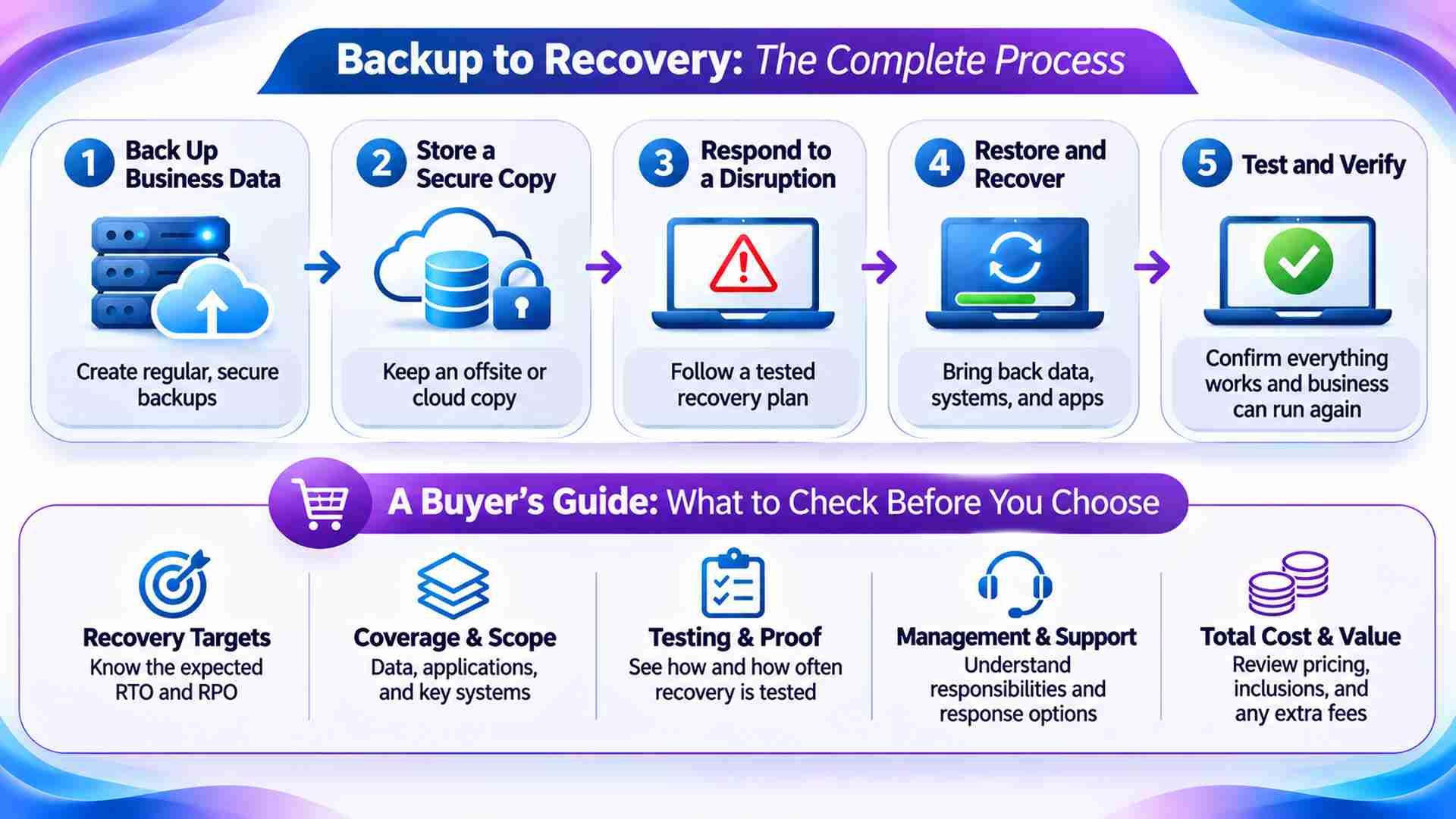
Recovery Time Objective (RTO) sets the target duration for restoring a service. Recovery Point Objective (RPO) defines the acceptable data loss window. Suppose the property manager chooses an illustrative four hours of downtime and one hour of lost updates. These are management decisions for this example, not published Dallas service commitments.
For Dallas owners to evaluate backup and disaster recovery fairly, each bid needs targets for individual services. Specify when timing begins, what counts as restored, and which dependencies are assumed available. A support acknowledgement within the agreed period is not evidence that staff can open the leasing application and use current records.
Separate Data Retrieval From Application Recovery
The data backup and recovery Dallas TX offices need depends on what failed. Recovering a lease document may require only a file restore. Reopening the property application can require its database, configuration, license, identity service, and compatible infrastructure. Identify these dependencies and assign responsibility for restoring each one before comparing bids.
Compare What Each Offer Actually Includes
Consider two hypothetical offers, not DEFCOR quotations or customer results. Offer A includes nightly file copies, retention, and remote file retrieval. Application rebuilding and incident coordination are excluded. Offer B adds application protection, controlled restore exercises, and a named recovery lead. Its acceptance report must document a usable application, not merely restored files.
Follow the Exclusions Through the Same Outage
If the leasing server fails, Offer A may return documents while leaving staff unable to record payments. Someone still needs to rebuild the application and reconnect access. Offer B addresses more of that work, but its recovery target remains conditional on the agreed dependencies. Neither offer should be evaluated from its storage allowance alone.
The right recovery scope may resemble either offer. With Offer A, the property manager needs a separate agreement naming who rebuilds the application and validates payments. With Offer B, those responsibilities belong in the provider’s scope, alongside dependencies, test criteria, and the process for correcting a failed exercise.
Compare the Cost of Equivalent Responsibilities
Assess the backup & disaster recovery services Dallas TX firms purchase by their full cost. Compare licensing, storage growth, testing, incident labor, replacement equipment, retrieval charges where applicable, and temporary hosting. Each bid should identify additional charges and approval arrangements before an urgent incident makes comparison difficult or leaves staff waiting for spending authorization.
Compare providers against the same recovery scope. If Offer A excludes rebuilding, add that supplier’s proposed fee to the comparison. If Offer B includes temporary hosting, establish its capacity, duration, licensing, and return process. A broader package is useful only when those capabilities fit the actual application.
Confirm Coverage at Your Dallas Address
The IT disaster recovery Dallas businesses arrange must work at their actual premises. Record the address, support hours, dispatch conditions, and escalation route. In a leased building, confirm who can admit a technician after hours and provide access to communications equipment. A technician arriving at a locked door has not restored service.
For an office served by Oncor, outage updates can inform temporary working arrangements; they do not set the IT provider’s recovery commitment. The recovery service a Dallas office selects should identify who checks utility status, when staff move to an approved alternative, and how they reach restored applications without office connectivity.
The backup & disaster recovery services Dallas TX offices compare should address simultaneous customer incidents. Confirm how the provider prioritizes requests and whether replacement hardware is reserved, sourced when needed, or customer supplied. A usable recovery plan must account for equipment availability and work assigned to other suppliers.
Verify the Controls Behind the Service Description
DEFCOR’s backup and disaster recovery service describes offsite copies, scheduled restore testing, and written recovery procedures. Use those stated capabilities to frame an assessment, then confirm the exact configuration and exclusions in the proposal. General service descriptions do not establish a particular customer’s recovery time or contractual protection.
For data backup and recovery Dallas TX staff can use during an incident, document protected systems, retention, and recovery access. Local copies and offsite copies address different failures. Offline storage or configured immutability can add protection, but deletion permissions, retention settings, and encryption key custody still matter. Product names alone cannot establish resilience.
Ongoing recovery services should include a working exception process. Someone must detect failed jobs, investigate them, and confirm protection resumed. Cloud email and shared files need explicit coverage decisions. Synchronization and native retention should be assessed against recovery requirements rather than assumed to provide an independent backup.
During an application supplier outage, exported tenant records might support a temporary process without reproducing the hosted application. The supplier may control service restoration even when your backup provider holds separate data copies. Record that boundary and how staff will capture requests securely, then reconcile them once the supplier restores access.
Agree on Acceptance Before Committing to Routine Service
An initial assessment can identify gaps without proving recovery. A paid pilot can demonstrate a limited scope before a broader commitment. An acceptance exercise verifies the installed service against agreed criteria. Settle the price, permissions, test boundaries, and treatment of a failed result before commissioning any of these activities.
The IT disaster recovery Dallas organizations prepare for equipment failure needs a separate path for suspected compromise. Qualified responders may need to contain the incident, preserve evidence, select trustworthy recovery points, and prepare a clean destination. Restoring files does not resolve information theft or establish that reconnecting systems is safe.
For the property manager, a controlled exercise should let an authorized employee retrieve a lease, check a known payment, and create a test maintenance request. Isolate the test environment and prevent customer messages, billing, or changes to live records. Acceptance should follow those operational results.
Offer A’s report might establish that a lease file was recovered. Offer B’s must record whether the employee completed the agreed application tasks, elapsed time, recovered data age, and exceptions. If either misses its own acceptance criteria, assign corrective work and a retest. Do not mark the whole environment accepted while a required task remains blocked.

Know When to Reject or Renegotiate
Evidence for the data backup and recovery Dallas TX buyers select should concern their actual systems. DEFCOR’s implementation portfolio provides context about its broader systems work, but unrelated deployments do not prove recovery performance. A useful supporting report identifies the environment, test date, tasks completed, and limitations rather than simply displaying a successful backup notification.
Before approving the IT disaster recovery Dallas suppliers propose, settle any gaps in ownership, evidence, and exit arrangements. These are reasons to pause selection or renegotiate scope, not requirements to buy the broadest package. A smaller service remains appropriate when a capable, named party accepts the excluded responsibilities and its work is budgeted.
The recovery service companies retain also needs maintenance after acceptance. Update the inventory and procedure after significant application, office, or access changes. If temporary hosting is used, reconcile payment and maintenance records before returning to normal systems. Keep recovery instructions securely accessible outside the environment they are intended to restore.
During a provider transition, verify the successor can restore an authorized export before the outgoing copies are deleted. Specify who supplies credentials, documentation, and any required software access. Retention and deletion decisions should follow approved business requirements, including any applicable preservation instructions. A cancellation date alone should not determine when the last usable recovery copy disappears.
- Reject an unassigned recovery role: identify who approves restoration, coordinates suppliers, and substitutes for the incident lead.
- Renegotiate unsupported targets: require the assumptions, acceptance test, correction process, and any additional recovery charges in writing.
- Resolve exit restrictions: obtain usable export formats, transition assistance, access handover, and an agreed deletion schedule.
Conclusion
Choose backup and disaster recovery services that Dallas staff can use against an agreed acceptance standard. Protect systems according to assessed business priorities, using one essential workflow to validate the design without treating the pilot as complete coverage. The property manager can choose Offer A or Offer B responsibly when the missing work has an owner, the full cost is understood, and demonstrated recovery matches the signed scope.
Frequently Asked Questions
Does a backup subscription include application recovery?
No. Confirm whether rebuilding applications, restoring access, and coordinating suppliers are included or separately assigned.
What determines the price?
Protected systems, retention, testing, storage growth, incident labor, and temporary infrastructure affect the total cost.
Does local coverage guarantee immediate attendance?
No. Confirm support hours, dispatch conditions, building access, and equipment availability for your address.
What should acceptance testing prove?
Authorized staff can complete agreed tasks within approved recovery targets using restored applications and verified records.
What happens when switching providers?
Verify usable exports, recovery access, transition responsibilities, and deletion timing before ending protection.
Defcor Team
. Part of the Defcor engineering team that builds and manages autonomous AI phone agents, IT systems, and automation infrastructure across Texas.