
- 01.AI phone agents can capture HVAC calls, collect details, and support scheduling.
- 02.Safety issues, unusual requests, and complex cases still need human escalation.
- 03.Reliable automation depends on clear rules, working integrations, and follow-up ownership.
Why HVAC calls are difficult to catch
Suppose a homeowner calls on a Saturday evening about an air conditioner that stopped cooling. The dispatcher has gone home and the on-call technician is inside another customer’s attic. Voicemail records a number but cannot clarify the request.
AI phone agents for HVAC can cover part of that gap by answering, collecting details, and following rules set by the business. The goal is fewer unanswered inquiries, not a guarantee that every call becomes a booked job. The outcome depends on appointment availability, connected systems, and a staffed escalation path.
Summer cooling calls may overlap while dispatchers coordinate technicians. The same problem arises with heating calls on cold evenings. Technicians cannot interrupt every job to answer.
Some callers leave a message; others try another contractor. An answered call is not automatically a job. During busy or closed hours, an AI phone agent can preserve the request, provided someone follows through.
A ringing phone is only the first step
A missed call report cannot reveal whether the caller wanted maintenance, a reschedule, or prompt attention. Compare logs with messages and callbacks. Morning overflow may need coverage; overnight safety calls need a different response.
What AI phone agents for HVAC do on a call
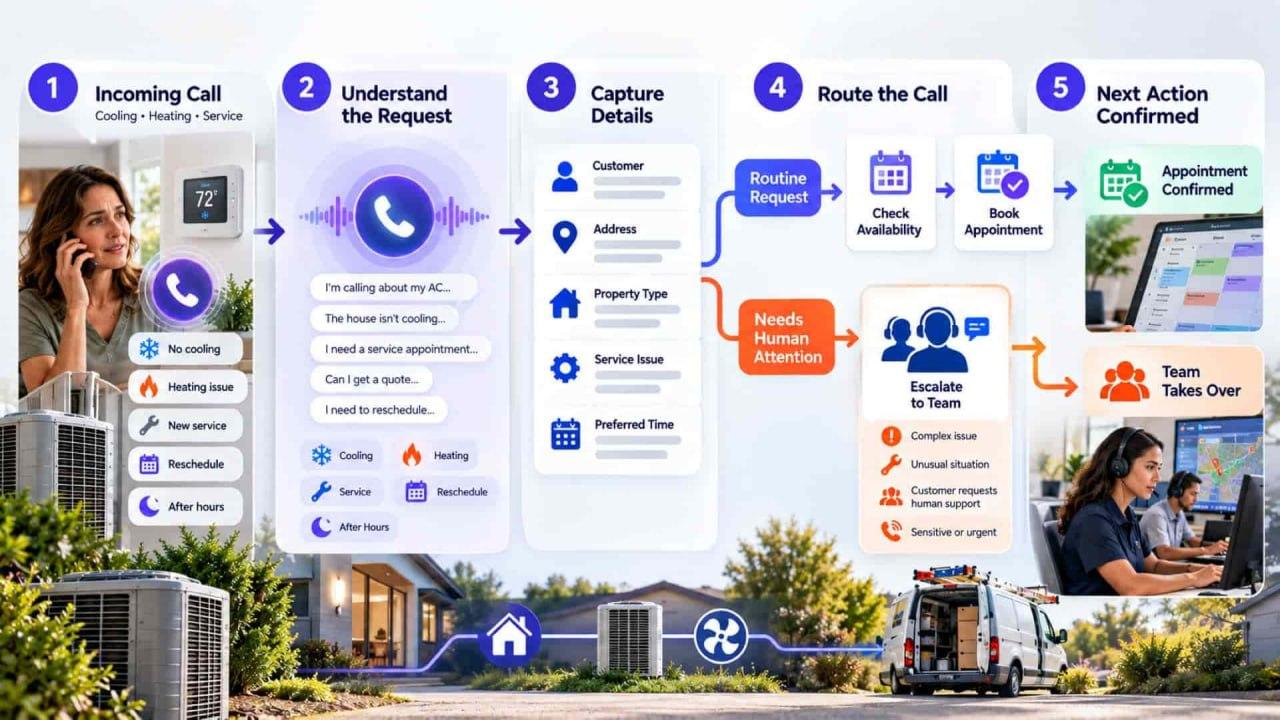
Depending on configuration, the agent answers on an assigned line or existing number. It asks what happened, then logs a request, checks approved availability, or transfers the caller. Calendar access needs limited permissions; a failed connection needs a fallback.
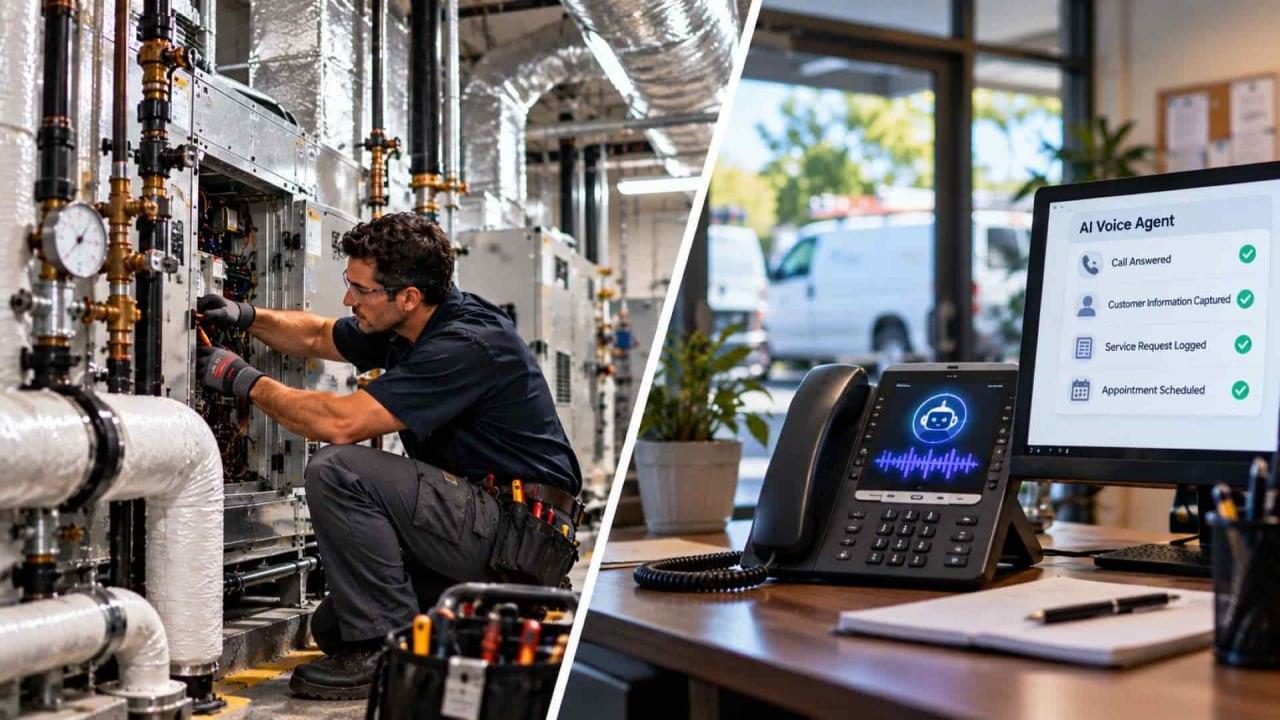
Voicemail stores a message without a conversation. A basic phone menu asks the caller to choose numbered options. A human answering service follows its own staffing procedures. A conversational AI agent can ask follow-up questions but may still misunderstand speech. DEFCOR’s comparison of AI and human receptionists discusses the division between routine phone tasks and human judgment.
An HVAC AI receptionist can help the office handle familiar requests. It cannot examine the equipment, and its answers should never promise a repair or arrival time that nobody has confirmed.
Follow the request from intake to action
A new service call needs usable details
Picture a homeowner whose upstairs system blows warm air. The caller gives an address, describes the problem, and asks for the first available visit. The agent can confirm the street number and collect a callback number, equipment type if known, and preferred time. At this point it has a service request, not a dispatched technician.
Now compare a returning customer who only needs to move a maintenance visit. Repeating new-customer intake would waste time and risk a duplicate job. The workflow needs a separate route that identifies the existing appointment or sends dispatch a reschedule request.
Booking needs a real scheduling rule
Back to the homeowner with the warm upstairs room: the calendar shows an opening tomorrow. Before confirming it, HVAC appointment scheduling automation needs to know whether the address is inside the service area and whether an available technician can make the visit. If travel time or technician availability lives only in the dispatcher’s head, the agent should collect a preferred window and leave the booking pending.
The caller should hear “we have your request; the office will confirm a time,” rather than “someone is on the way.” Dispatch assigns a technician under current conditions. The scheduling workflow can confirm only what the connected schedule and company rules actually authorize.
Closed hours need an ownership plan
An after-hours HVAC answering service can capture a request and state when the office expects to respond. A written policy may alert an on-call employee for certain calls. If nobody can respond until morning, say so plainly. Answering at midnight does not mean offering midnight repairs.
For the homeowner in our example, the record must reach whoever confirms next-day visits. If it sits in a shared inbox without an owner, the conversation accomplished little beyond voicemail. That handoff matters more than how natural the voice sounded.
Set hard limits for dangerous calls
Some callers may mention a gas smell, a carbon monoxide alarm, smoke, fire, or an electrical hazard. These are safety signals, not ordinary scheduling categories. The agent must not diagnose equipment or guide repairs. For a sounding carbon monoxide alarm, CDC guidance says to leave the home immediately and call 911. For a suspected natural-gas leak, PHMSA advises leaving the area and calling 911 from a safe location. The agent should follow approved emergency wording rather than diagnose equipment or improvise. An on-call alert cannot substitute for emergency help.
Responsible staff should approve the wording and test indirect warnings, such as “the detector keeps beeping.” An after-hours HVAC answering service needs a safe fallback when the call is unclear or a transfer fails.
Human judgment matters on ordinary calls, too. A dispatcher might see an open calendar slot but know the available technician lacks the needed experience or is too far away to make it. The system can pass along the caller’s description and preferred time. The dispatcher decides whether that slot is genuinely available.
Build a useful partnership with the office
An HVAC AI receptionist may handle common questions, capture routine requests, and take overflow while staff coordinate work. Employees still resolve disputes, unusual warranty issues, and complex scheduling. Callers requesting a person need a clear transfer or callback path.
The handoff should answer three practical questions for the employee:
During a summer surge, recorded calls still leave dispatch guessing if nobody knows which require callbacks. A short summary tied to an owner puts pending requests first.
- What did the caller request, and what details were confirmed?
- What action did the system take or decline to take?
- Who owns the next response, and when was it promised?
What implementation really involves
Before choosing a voice, trace a repair request from a neighboring town. Who checks the service area, approves calendar availability, and calls back if no time is confirmed? Those answers shape the call-handling rules and reveal where existing systems might create duplicate work.
Check the connections before confirming a visit
DEFCOR describes AI phone agent services that include intake, routing, booking, and human escalation, with dispatch integrations where supported. A particular HVAC platform still needs a compatibility review. A calendar showing openings may not support creating jobs or assigning technicians. HVAC appointment scheduling automation needs testing against real scheduling constraints before it confirms visits.
Keep caller information and routing current
An intake call contains a customer’s address and number, sometimes alongside a recording or transcript. Decide who can see those records, how long they remain available, and what a connected account may change. Disclosure and recording requirements can vary by jurisdiction, so the business should review applicable rules before enabling call recording or transcription. In testing, use addresses that sound alike, a noisy service call, and a caller who changes the requested time. Switch off the calendar connection, too: the agent must know how to take a message when it cannot safely book.
An HVAC AI receptionist also needs someone to keep its information current. An outdated on-call list can route a perfectly understood request to the wrong person. Reviewing mistakes helps locate stale information or a faulty rule.
Compare coverage against the work it creates
Choose the reception model by call type
Voicemail plus a dependable callback process may suit a company with few overnight inquiries. A human answering service offers a person to speak with, but its ability to book or escalate depends on its staffing and instructions. AI phone agents for HVAC can ask structured follow-up questions and, when connected systems permit, act on a calendar or customer record. A hybrid model can cover repeatable intake while the office keeps disputes, unusual requests, and dispatch decisions. Compare what callers need during each time window, not just how often the phone rings.
Count the cost of unfinished work
An after-hours HVAC answering service should be compared on total operating work: service fees, setup, telephony usage, integrations, staff review, callbacks, and the time spent correcting bad bookings. A lower monthly quote may cost more to operate if dispatch must re-enter every request. Listen to calls from both an ordinary week and a seasonal rush; identify which became confirmed visits, which stayed pending, and which needed a person. The useful outcome is a correctly handled request, not an impressive answer rate.
Conclusion
Start with overflow calls in one service area and compare test-call notes or recordings, where enabled, with customer records. Check address accuracy, whether a visit was confirmed or only requested, successful transfers, and requests still awaiting a callback. Review failures with dispatch each morning. A misrouted safety concern or a booking promised without availability should stop expansion until the rule is corrected and the call is tested again.
Use the results to choose a scope. If intake is accurate but calendar access is unreliable, keep AI phone agents for HVAC on information capture and let staff confirm visits. If bookings, transfers, and callbacks work as intended, expand coverage gradually. If requests still sit without an owner, repair the handoff before adding calls. The DEFCOR team can review that proposed scope against your phone and scheduling setup, including calls that must reach a person.
Defcor Team
. Part of the Defcor engineering team that builds and manages autonomous AI phone agents, IT systems, and automation infrastructure across Texas.