
- 01.Local SEO starts with accurate business information, real service coverage, and pages that match what customers are actually searching for.
- 02.Google Business Profile optimization should focus on correct categories, hours, contact details, service areas, and genuine customer reviews.
- 03.Measure qualified inquiries and completed customer actions, not rankings, clicks, or visibility alone.
Define the Customers and Locations You Can Serve
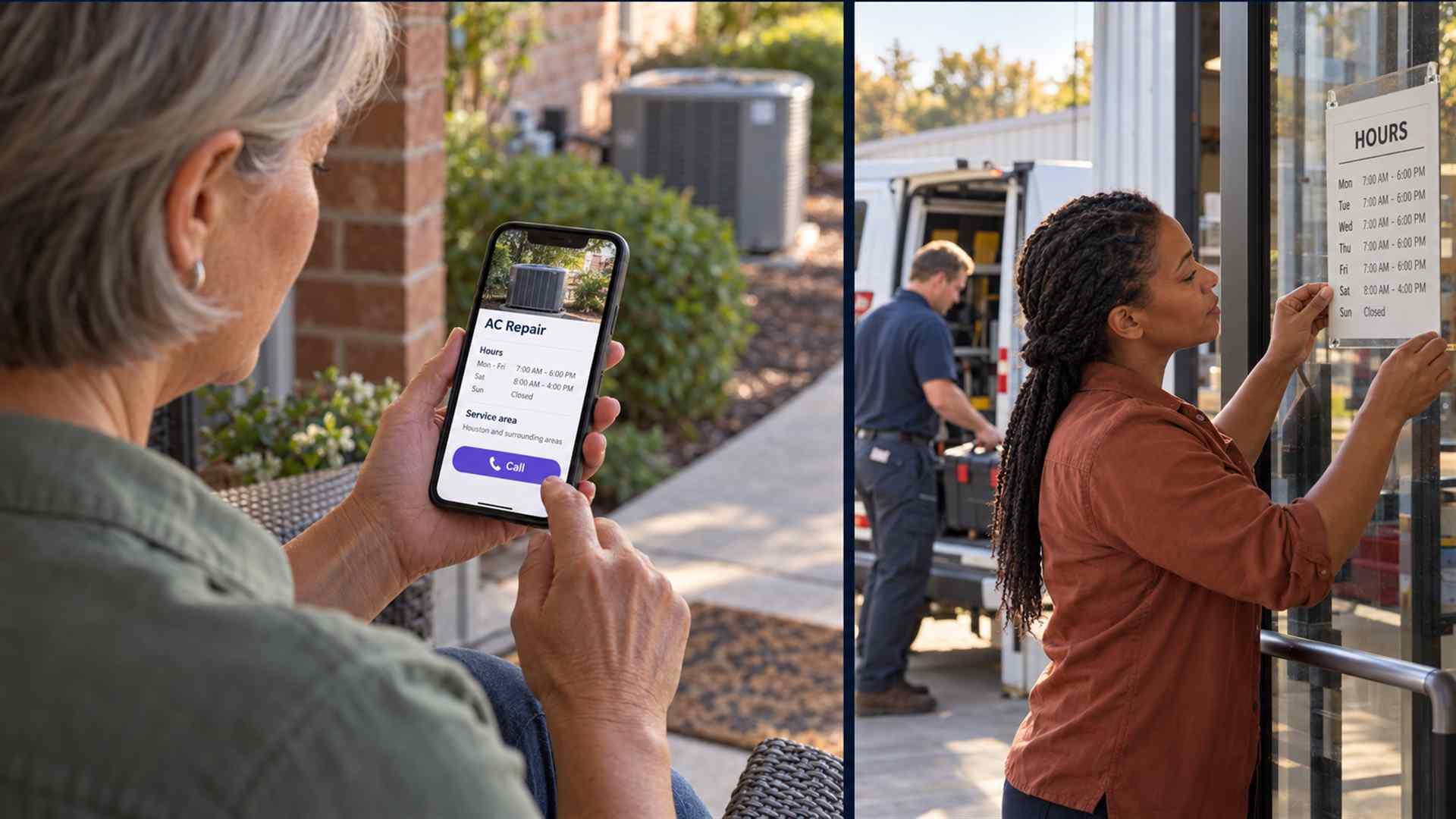
Consider a hypothetical Houston AC contractor whose listing shows outdated hours. A homeowner taps through, struggles with the mobile page, and cannot confirm coverage. The company appeared in search, but the customer still lacks enough information to choose it. Effective local SEO for small businesses connects accurate listings, useful service pages, and a working inquiry path. Start with one service and follow the customer’s next steps before spending more on visibility.
Local SEO helps businesses appear for searches with local intent. Map listings, regular website results, and paid placements are different channels; buying advertising does not buy a better organic local ranking. Begin with your actual services and coverage. For the Houston contractor, residential repairs and maintenance qualify, while industrial installations and addresses outside its operating area do not.
Use customer questions to choose page topics. “AC repair Houston” suggests a breakdown; “AC maintenance Houston” suggests preventive work. These examples illustrate intent, without establishing search volume. Compare available Search Console queries with questions staff receive, then group phrases by the service needed. One strong service page can answer several phrasings of the same request. Separate repair and maintenance pages when their scope and customer decisions genuinely differ.
Understand What Affects Map Visibility
Google identifies relevance, distance, and prominence as major local ranking factors. Accurate details explain your activity, while distance depends on the searcher’s location. Owners asking how to rank higher on Google Maps should therefore specify the service and neighborhood they mean. A position checked from the contractor’s office cannot represent every homeowner’s results across Houston, and no provider controls all those factors.
Record a Baseline Before Making Changes
Before editing, save profile details, priority page URLs, and recent inquiry records. Date any ranking checks and record the search location. Measure performance against a defined objective: more residential repair requests from covered areas, for example. Note seasonal demand and advertising changes so they are not mistaken for an SEO effect.
Make Your Business Profile Match the Real Business
Google Business Profile optimization starts with eligibility and checking for an existing listing. Claim the appropriate listing if one exists; create a profile only when needed and eligible. Check verification status and follow the methods Google offers for that profile. A particular method may not be available. Keep primary ownership under the business’s control, give contractors appropriate access, and check business verification separately from account access.
Choose Accurate Categories and Operating Details
Use the name customers recognize from signage and the website, without adding promotional keywords or city names that are not part of it. Choose the primary category closest to the main business activity, then add only relevant categories. For the contractor, compare the category description with the work actually offered. Check phone routing, website destination, regular hours, and holiday exceptions.
Separate a Storefront From a Service Area
If the contractor visits customers and does not receive them at its address, that address should be hidden on the profile. List genuine service areas instead. Do not create virtual offices to imply branches in target cities. Adding service areas does not remove distance from ranking. Google Business Profile optimization should describe where the business operates, without implying a staffed location where none exists.
Add genuine photos that help customers recognize the team and understand the service, with appropriate permission and no sensitive details. Assign someone to review hours and numbers after staffing or schedule changes. Ongoing local visibility work includes checking what customers actually see, especially when holiday hours differ from the usual schedule.
Build Service Pages That Help Customers Decide
The homeowner searching for a repair should reach a repair page, not a vague list of everything the company does. A descriptive title such as “Residential AC Repair in Houston” works only if the page supports that promise. Explain symptoms the service addresses, coverage, what happens after an inquiry, and any genuine limits. Describe maintenance separately when its scope differs.
Give Location Pages an Independent Purpose
Do not make a Dallas page by replacing “Houston” throughout the copy. A useful location page needs genuine coverage information, relevant work examples where permitted, or other details that help customers there. If nothing distinct exists, improve the main service page. Producing similar city pages just to capture searches and funnel visitors elsewhere can create doorway page risks.
Test the Website and Inquiry Path
With access to the correct Search Console property, enter the repair page’s full URL in URL Inspection. Review its indexing status and any stated reason for exclusion; use the live test to check current accessibility after relevant fixes. A successful test does not guarantee indexing or ranking. Business structured data likewise does not guarantee special search features; never expose a private address just to fill a template.
Then test the page on a phone: tap the number, submit a labeled test request, and confirm the office receives it. Check that form errors explain what needs correcting. If delivery fails, provide a working phone option while the website provider repairs the form. DEFCOR’s WordPress and custom website comparison discusses testing representative pages and request workflows. A platform label alone does not establish whether these tasks work on your site.
Build Local Credibility Through Genuine Experience
Check business details on your website, important directories, and relevant trade association listings. Fix an old number or misleading address before worrying about minor punctuation differences. Seek local connections that would make sense even without a search benefit. Bulk directory submissions and purchased link packages do not replace useful participation in the communities or industries you serve.
After completed work, send a neutral review request to customers with genuine experience, without filtering for satisfaction first. Do not offer discounts, buy ratings, or pressure customers about what to write. A complaint deserves a courteous response and private investigation, without public disclosure of personal details or a demand to remove the review before receiving help.
When discussing how to rank higher on Google Maps, distinguish genuine reviews from an activity quota. More reviews and positive ratings can help local ranking, but do not neutralize distance or competition. Google Business Profile optimization also needs honest expectations: answering a phone overnight does not mean a technician is available for an overnight visit.
Use a Checklist Your Team Can Maintain
Keep the work manageable by starting with one service and its inquiry path. Use this local SEO checklist as a work sequence, not a ranking timetable. Assign each correction to a named person and retain evidence of completion. A saved setting is worth checking from the customer’s view, especially after changing hours or a destination link.
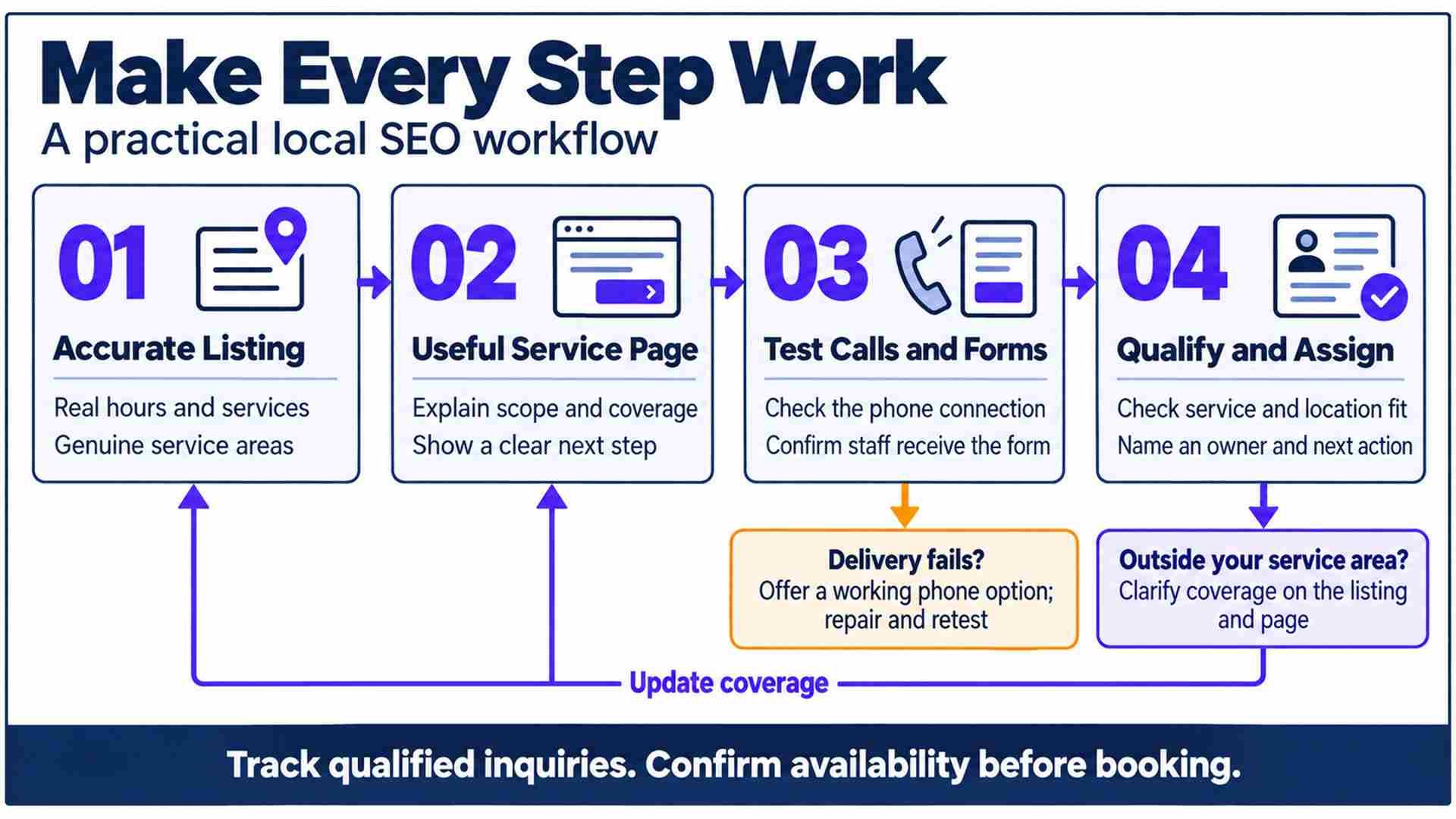
Revisit your local SEO checklist monthly. For our contractor, a repair inquiry from an uncovered address suggests reviewing coverage language or targeting. A suitable request left unanswered points to the office workflow. Neither problem is solved simply by adding pages. Log changes and their dates so the next review can connect a suspected problem with the correction attempted.
If you outsource local SEO for small businesses, ask for implemented fixes, not just an audit. DEFCOR’s SEO and website optimization services cover technical foundations, local presence, and service content. Agree which pages and listings are included, who can approve changes, and how the provider will demonstrate that the agreed work was completed.
- First week: check profile eligibility, ownership, verification status, categories, hours, phone number, and genuine service coverage.
- Second week: improve the repair page, inspect indexing, and test mobile calls and form delivery.
- Ongoing: request honest reviews, correct important listings, and review qualified inquiries alongside their next action.
Measure Qualified Inquiries Rather Than Positions Alone
Business Profile performance counts call button clicks, which do not establish whether a conversation occurred, and can include organic and advertising interactions. Search Console shows search activity; correctly configured GA4 measures website behavior. To evaluate performance, match those signals with inquiry records. Keep their definitions separate, because the same customer may appear at several points along the journey.
Use a simple inquiry log: date, known source, requested service, coverage fit, qualification, and next action. Leave the source unknown when evidence is missing. Mark tests and duplicates separately. In our example, a covered residential repair request awaiting a callback is qualified but not booked. Someone must confirm availability; a submitted form is not a dispatched technician. Keep customer details limited to what the task needs.
Compare similar periods and note advertising, staffing, and seasonal changes. Ask providers for evidence matching the claim. For example, DEFCOR’s J Solutions project describes conversion planning and public form setup. That is a documented implementation scope; a claim of improved Maps rankings would need separate search data. Likewise, an increase in inquiries after a change needs investigation before attributing it to SEO.
Conclusion
Complete the first pass of your local SEO checklist before expanding to another service or city. If suitable inquiries arrive but remain unresolved, fix that handoff before buying more traffic. The useful answer to how to rank higher on Google Maps starts with the service, location, and problem you can actually address. Expand local SEO for small businesses when evidence supports the next investment and your team can maintain the work already completed.
Frequently Asked Questions
How long does local SEO take?
Timing varies with competition, existing problems, and implementation. Track qualified inquiries rather than expecting a guaranteed ranking date.
Can I manage it myself?
Owners can maintain accurate details and request honest reviews. Indexing issues or broken forms may need technical help.
Does adding service areas improve Maps coverage?
Listing more areas does not remove distance from local ranking or establish physical branches.
Which results should I measure?
Record service needs, coverage fit, qualification, known source, and next action. A call button click does not prove a conversation or sale. Leave unconfirmed sources marked unknown.
Defcor Team
. Part of the Defcor engineering team that builds and manages autonomous AI phone agents, IT systems, and automation infrastructure across Texas.