
- 01.Compare web design companies using the same brief and equivalent deliverables, not price or portfolio appearance alone.
- 02.Review relevant live work and verify who will actually design, build, support, and maintain your website.
- 03.Clarify ownership, ongoing costs, support responsibilities, and acceptance criteria before signing the agreement.
Look for Design Judgment in Relevant Work
When comparing providers through their portfolios, select two projects with comparable customer tasks. Confirm which parts the provider created and whether another team has since changed them. Open the live sites: screenshots cannot show whether navigation works or customers can complete an inquiry.
How to Evaluate a Web Design Portfolio
On a phone, open a service page as though you were a new customer. Can you identify the offer, location, and next step? Notice whether headings establish a clear reading order, text remains comfortable to read, and images support the service. Buttons should describe the action, while decorative effects should leave important information and navigation easy to use. Check whether colors, imagery, and tone suit the business consistently across pages.
Ask the designer how to evaluate a web design portfolio beyond personal taste. Ask why the team chose that page structure and what customer uncertainty it addresses. A law firm, for example, needs accurate practice information and credible attorney profiles. An attractive layout cannot compensate for vague service descriptions or content the business has not approved.
Separate Useful Evidence From Unsupported Results
DEFCOR’s J Solutions project illustrates a useful distinction. Its published account describes a launched public website and a separately defined client portal architecture and review process. A portal plan is a different deliverable from an operating portal. When reviewing comparable work, establish what was designed, built, and launched. Use the distinction to require a separate acceptance milestone for every promised feature. If results are quoted, request the baseline, measurement period, and other changes made; a percentage alone cannot establish design effectiveness.
Any explanation of how to evaluate a web design portfolio should include accessibility. Try keyboard navigation and look for a visible focus indicator. Ask how the team tests forms and handles accessibility issues. Simple checks can expose problems, but they do not establish full accessibility. When detailed assessment is needed, identify its scope and who performs it.
Find Out Who Will Actually Deliver
A capable salesperson may have little involvement after the deposit. Meet the delivery lead and establish who handles design, development, content, and approvals. The most revealing questions to ask a web design company concern decisions that can delay your project: missing copy, unavailable software access, late feedback, and changes to the agreed scope. Request a schedule that shows those dependencies.
Questions to Ask a Web Design Company
Bring a scenario that tests the proposal. A visitor submits a request and sees a success message, but your office receives nothing. Have the provider explain how it would trace the submission, identify a failed connection, and notify staff. Website submission, email delivery, CRM entry, and confirmed booking are separate steps; the proposal should identify which are included and who checks them.

Who writes and approves the content, and how many revision rounds does the price include?; What will you demonstrate before acceptance, and who corrects defects found during that review?; Who handles urgent failures after launch, during which hours, and at what additional cost?
Use the same questions to ask a web design company across interviews. Then speak with a recent client about communication and unexpected charges. When speaking with a recent client, focus on what they would clarify before signing again. Compare their experience with the promises in your proposal, including who handled problems after launch.
Choose the Team Structure Your Project Needs
The web design agency vs freelancer comparison becomes useful when you identify the skills and availability required. A freelancer may offer direct access to the person doing the work. An agency may coordinate several specialists, with additional handoffs. Check the named team and its current capacity: a company label does not tell you who will handle your project or cover an absence.
Match Resources to the Consequences of Delay
Consider two illustrative projects. A small accounting practice needs service pages, an inquiry form, and occasional content changes. A capable freelancer with documented handover and backup support may fit. A property management business needs separate location journeys, a portal connection, and several internal approvers. That scope may favor a coordinated team, provided it demonstrates the necessary skills and assigns a delivery lead.
Resolve the web design agency vs freelancer decision by checking who can complete the difficult work and support it afterward. Some freelancers have specialist partners; some agencies rely on one developer. Capacity is easy to overlook during the selection process. Establish who receives documentation and takes over if the main contributor becomes unavailable.
Compare the Cost of the Same Deliverables
Place each quote into three categories: initial build, recurring costs during the first year, and potential exit costs. Include content, migration, hosting, software licenses, training, and agreed support. Identify optional work separately. A cheaper build can carry higher ongoing charges, while a larger proposal may include services you do not need. Get exclusions and renewal assumptions in writing before comparing totals.
In the web design agency vs freelancer comparison, account for work left to your staff. Copywriting and coordination still require time when excluded from the invoice. For each deliverable, record whether it is included, optional, excluded, or awaiting discovery. Then request a price and schedule impact for the same change, such as adding a service page after design approval. Compare totals only after the essential items have a defined cost or an explicit allowance.
Suppose one proposal includes a CRM connection without naming the platform, while another prices discovery before committing. The first is not necessarily more complete. Compatibility depends on available interfaces, permissions, and configuration. Resolve what happens if access is unavailable and how the price changes. A request should only appear as a confirmed appointment once the required booking steps have succeeded.
Compare technical claims before choosing a provider. Ask which existing URLs will redirect, who prepares page titles, and how important pages will be checked after migration. A speed report should identify the page and test conditions. Search visibility remains an outcome influenced by multiple factors; a first-place ranking promise is a reason to challenge the offer.
Make Ownership and Acceptance Practical
Your business should retain appropriate control of its domain and essential accounts. Establish what source files, design assets, content, and documentation you receive, and which licensed components have transfer restrictions. Request a handover list containing account owners, renewal dates, support arrangements, and export instructions, with credentials transferred securely. Have a staff member demonstrate an ordinary content edit before signing off.
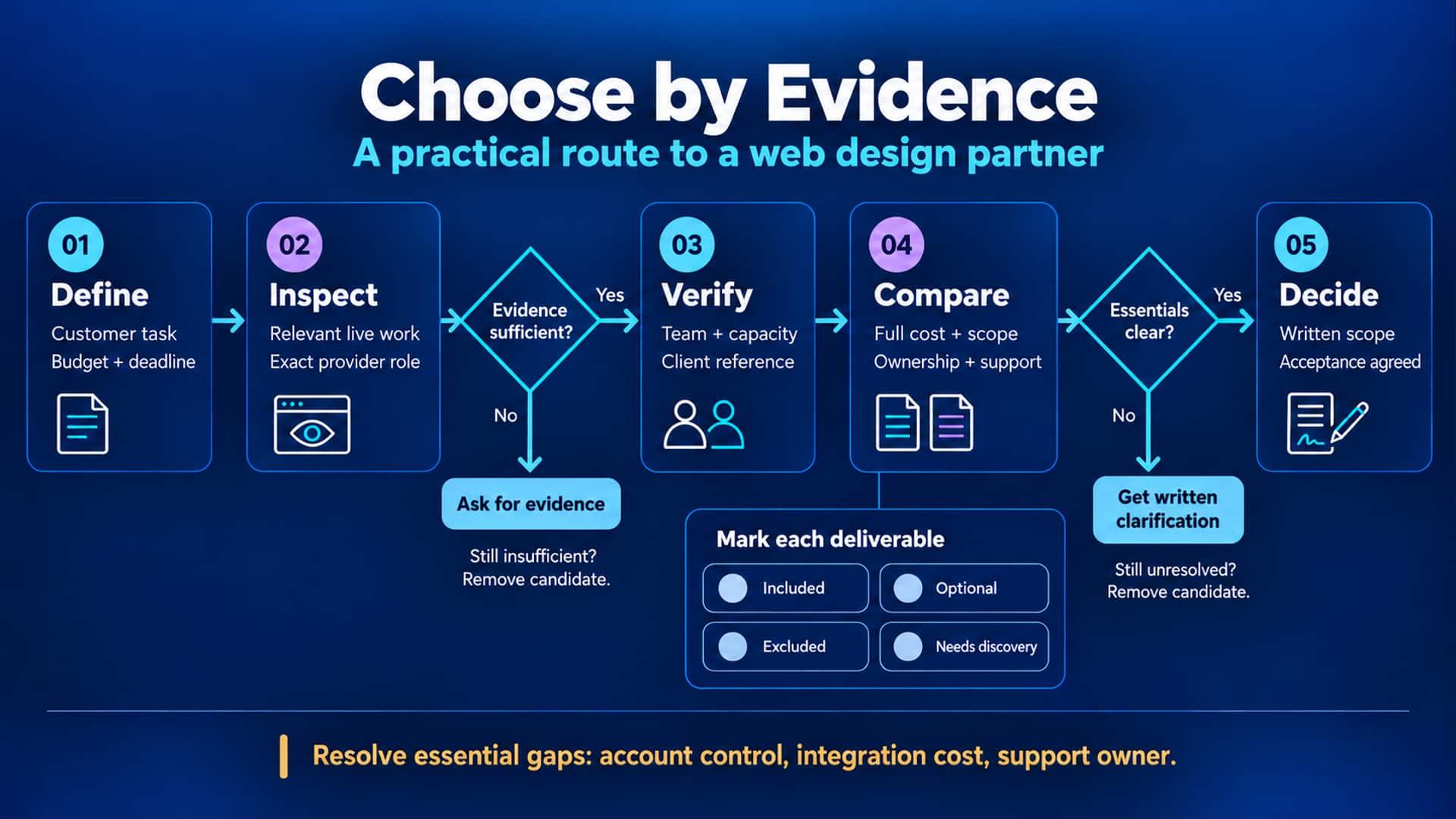
If you are debating how to choose a web design company, compare support through a practical scenario. Ask who fixes a broken form, who updates business hours, and who builds a new booking feature. DEFCOR’s guide to website management for small businesses explains why these responsibilities need separate scope. Confirm response coverage and distinguish acknowledgment of a fault from its resolution.
Set acceptance criteria before work begins. Witness the priority customer journey using approved test details, verify delivery to the intended employee, and record defects and correction dates. Missing access details can be clarified; refusal to provide agreed business control is a stronger reason to reject a candidate. Unexplained ownership restrictions and integration promises without feasibility checks should also prevent an unqualified approval.
Conclusion
Reduce the shortlist to providers that meet your essential requirements, then compare their evidence, total cost, and working relationship. Knowing how to choose a web design company also means recognizing when a smaller scope is appropriate. If the budget cannot cover every feature, defer a lower priority feature rather than leave a critical customer journey unfinished. Make that tradeoff explicit in the signed scope.
Frequently Asked Questions
Should I choose the cheapest website proposal?
Compare equivalent deliverables, recurring charges, and work your staff must provide before judging value. Clarify ongoing responsibilities too.
Who should control the domain?
Your business should retain appropriate account control, with provider access and transfer restrictions documented.
Does a portfolio prove commercial results?
No. Confirm the provider’s role, measurement period, and other changes that could have influenced outcomes.
What should happen before final acceptance?
Test the priority customer journey, confirm inquiry delivery, review mobile usability, and verify staff access. Record outstanding defects and agree correction dates with the responsible provider before signing off.
Defcor Team
. Part of the Defcor engineering team that builds and manages autonomous AI phone agents, IT systems, and automation infrastructure across Texas.